There’s a moment at the end of every CMMC assessment that feels bigger than most people expect.
The assessor closes their laptop. The final questions have been answered. The evidence has been reviewed, clarified, and confirmed. The out brief has been performed. The certificate is in hand.
And then it’s done. Congratulations, you’re certified!
For many organizations, that moment feels like crossing a finish line.
After months of scoping, ownership debates, documentation iterations, technical changes, and mock assessments, there’s a natural sense of relief. You made it through. The hard part is over.
It’s a milestone worth celebrating. But it’s not the end.
In reality, it’s the point where your compliance program stops being preparation and becomes permanent.That shift matters more than most people realize.
Because everything you built leading up to the assessment wasn’t meant to survive just long enough to pass. It was meant to become how your organization operates every day, whether anyone is watching or not, and this is where some organizations quietly lose momentum.
Not because they don’t care, but because the urgency fades. The deadline is gone. The pressure from the upcoming assessment no longer exists. The calendar no longer has a date circled in red. Without that external forcing function, compliance must stand on its own.
The organizations that treat the assessment as the finish line tend to drift. The ones that treat it as a checkpoint keep moving.
So, what actually comes next?
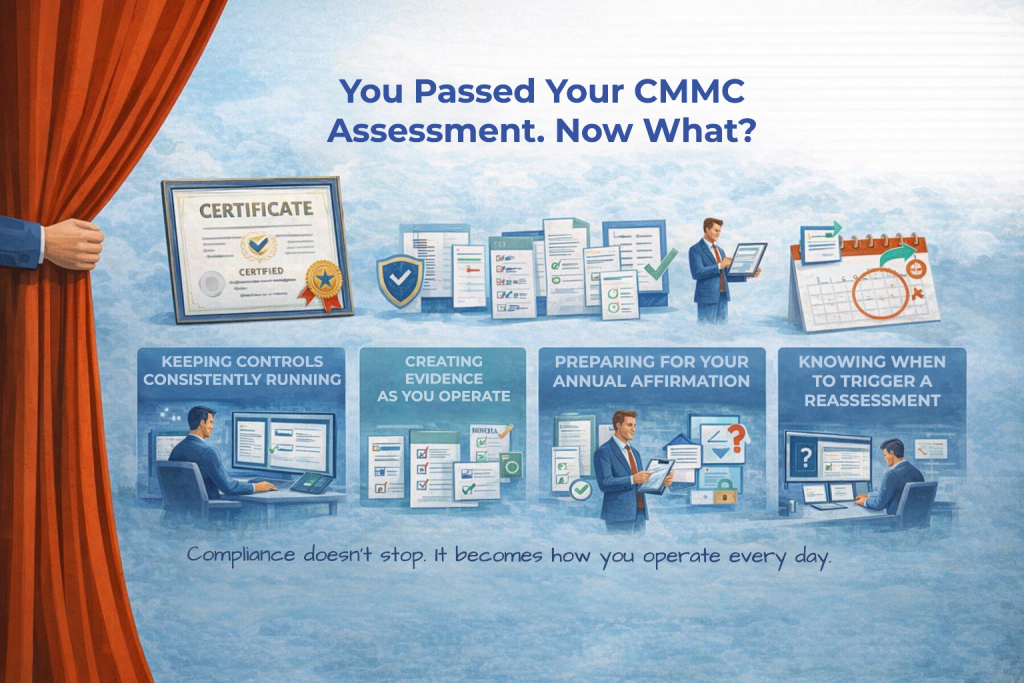
First, there’s the reality that CMMC isn’t a one-time certification, but a continuous obligation. That means the controls you implemented aren’t something you maintain occasionally. They need to operate consistently, predictably, and defensibly over time.
Access reviews still need to happen on a defined cadence. Log reviews still need to be performed, not just configured. Vulnerabilities still need to be tracked, prioritized, and remediated. Incidents still need to be handled, documented, and learned from.
The difference now is that you’re no longer building these processes. You’re sustaining them. That sounds simpler than it is, because sustaining controls requires a different kind of discipline.
During the build phase, teams are focused. Changes are visible. Progress is easy to measure. Everyone knows what’s being worked on.
During the sustainment phase, success becomes quieter.
Things happen on schedule. Reviews are completed without escalation. Evidence accumulates naturally. Nothing feels urgent.
And that can be deceptively difficult to maintain, because consistency, over time, is what turns a compliant environment into a mature one. This is where ownership matters as much, if not more, than it did during implementation. Every control still needs someone responsible for it, not just in documentation, but in practice.
Who is accountable for reviewing access? Who ensures logs are actually reviewed, not just stored? Who verifies that procedures are being followed when incidents occur?
If those answers were clear during the assessment, they need to stay clear now. If they start to blur, gaps begin to reopen quietly. And those gaps don’t show up immediately. They show up months later, when evidence doesn’t tell a consistent story anymore.
That brings us to one of the most important elements of post-assessment life: evidence.
Before your assessment, evidence was something you were very aware of. You gathered it. Organized it. Validated it. Practiced presenting it. After your assessment, evidence should become something you’re almost unaware of. Not because it’s unimportant, but because it’s being created naturally.
Tickets reflect real work. Logs reflect real activity. Reviews reflect real decisions.
When someone asks for proof, it should already exist without needing to be recreated. That’s the difference between preparing for compliance and operating within it, and it’s also what makes the next requirement possible: your annual affirmation.
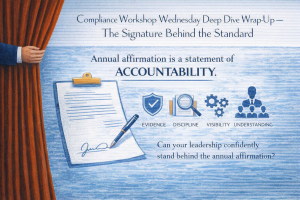
At least once a year, your organization will be required to officially affirm that you continue to meet the requirements of your CMMC level.
On the surface, this sounds simple. You’ve already passed your assessment. You’re already compliant. Why wouldn’t you be able to affirm that? But the affirmation isn’t based on what your environment looked like during your assessment, it’s based on what your environment looks like now.
At the moment you attestate, you’re effectively saying:
“Yes, the controls are still implemented. Yes, they are still functioning as intended. Yes, we have maintained them continuously.”
That means your ability to confidently make that statement depends entirely on what’s happened in the months since your assessor left. If your processes have been running on cadence, if your ownership has remained clear, if your evidence has continued to build naturally, then affirmation becomes a straightforward exercise.
If not, it becomes much harder, because affirmation isn’t meant to be optimistic, it’s meant to be accurate. And that’s why the sustainment phase matters so much.
But there’s another reality organizations need to be prepared for: Not every change in your environment is neutral. Some changes are significant enough that they can impact your scoping, your controls, or your compliance posture as a whole.
In certain cases, those changes can trigger the need for reassessment, and this is the part that often catches organizations off guard. During implementation, everything is deliberate. Changes are planned, reviewed, and aligned with your compliance objectives. After the assessment, changes are often driven by business needs.
New systems get introduced. Existing platforms get replaced. Workflows evolve. Staff roles shift. Infrastructure expands or contracts.
Individually, these changes may seem routine. Collectively, they can alter the environment your assessment was based on. If the changes impact systems handling controlled unclassified information, or affect how controls are implemented or inherited, they can potentially require you to reassess.
Not because you did something wrong, but because your environment is no longer the same environment that was originally assessed. This is why sustained scoping awareness is so important. You don’t stop thinking about scope after your assessment; you continuously evaluate it, and when something changes, you ask:
Does this system now touch CUI?
Does this introduce a new dependency?
Does this change how a control is implemented or enforced?
Those questions don’t only belong in the beginning of your journey; they belong in your ongoing operations. And this brings us back to why passing your assessment is a milestone, not a destination.
What you’ve proven at that point is that your organization can operate in a compliant, controlled, and defensible way. What you do next determines whether that capability lasts.
Mature organizations don’t treat compliance as a project that ended. They treat it as a function that continues.
They build cadence into their operations. They revisit ownership when teams change.
They update documentation as reality evolves. They validate themselves before someone else has to.
They don’t wait for the next assessment cycle to find out where they stand. They already know. And that confidence doesn’t come from memory, it comes from discipline, because the real goal was never just to pass, it was to build something that could stand on its own. Something that doesn’t rely on deadlines or external pressure to stay intact. Something that reflects how the organization actually operates, day in and day out.
If you’ve reached this point, that’s what you’ve started.
Now the focus shifts from proving it once to proving it continuously, not in a stressful, high-pressure way, but in a steady, predictable, and sustainable way. That’s the difference between compliance as an event and compliance as an operating model, and that’s where real value lives.
Because when your controls are consistent, your ownership is clear, and your evidence tells a continuous story, assessments stop being something you prepare for and become something you’re always ready for.
That’s what maturity looks like after the milestone.
And that’s what comes next.
Questions about CMMC certification? Contact Hill Tech Solutions.