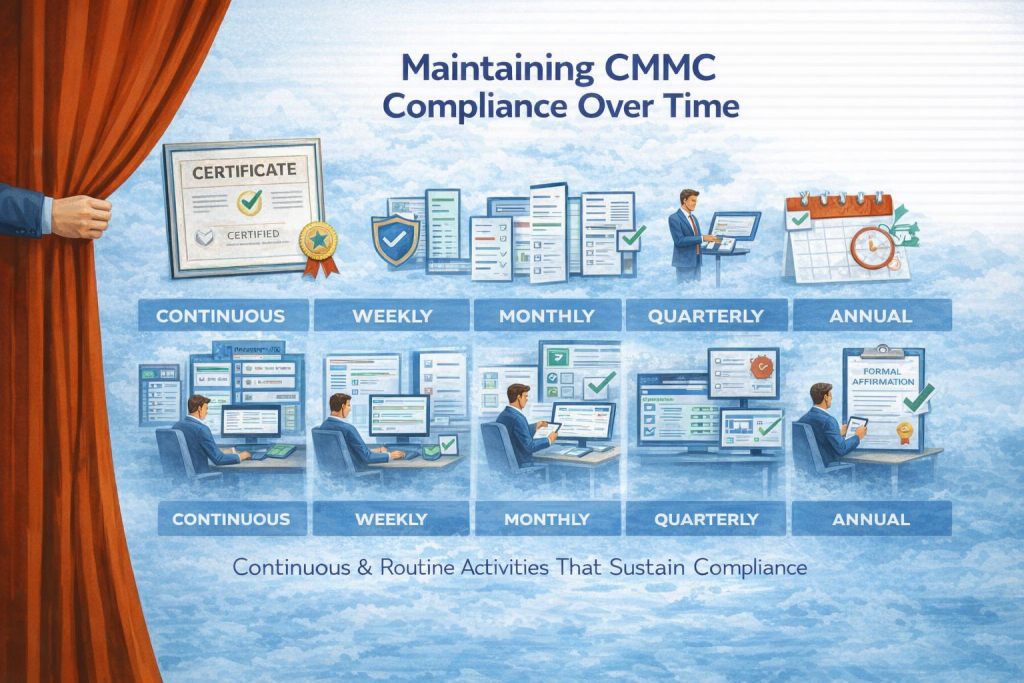
In our last Compliance Workshop Wednesday installment, we focused on what happens right after the assessment ends and why certification is not the finish line. This next step builds on that idea by breaking down the operating cadence required to keep CMMC real over time, from continuous monitoring through weekly, monthly, quarterly, and annual activities.
CMMC doesn’t require you to maintain controls occasionally. It requires you to operate them continuously. The difference between the two is cadence.
Not as a theoretical concept, but as the structure that determines whether your compliance holds next month, next quarter, and next year. While this cadence is defined by you with some minimums required, here’s what we have found successful.
The Shift From Building to Operating
During your journey, everything centered around building. You implemented controls, aligned documentation, defined ownership, and prepared evidence. There was urgency, focus, and a clear goal.
After the assessment, that urgency is replaced with something quieter and harder to sustain, consistency. Controls don’t just need to exist; they need to run. Evidence doesn’t just need to be gathered; it needs to be generated. Ownership doesn’t just need to be defined; it needs to persist, and that only happens if your organization moves from “project mode” into a defined operating cadence.
What Cadence Really Looks Like
Cadence is not one schedule. It’s a layered rhythm of activities that operate at different intervals, depending on the control. When cadence is working, controls don’t feel forced, they feel routine. When it’s missing, controls still exist on paper, but the execution starts to drift.
Continuous: What Always Has to Be Running
Some controls never stop. They operate in real time, whether anyone is actively thinking about them or not. Monitoring is happening, alerts are firing, systems are generating logs, incidents are being detected and responded to.
This is the foundation of your environment. But continuous activity alone is not enough, and collection is different from execution. Logs being generated does not mean logs are being reviewed. Alerts being triggered does not mean alerts are being acted on.
Continuous controls provide visibility and review cadence makes that visibility meaningful.
Weekly: Where Operational Discipline Starts to Show
This is where many organizations begin to separate.
At a minimum, there needs to be a regular cadence where the environment is reviewed intentionally. Logs are looked at, not just stored. Vulnerabilities are identified and assessed. Backups are checked to ensure they are completed successfully.
For smaller organizations especially, this is often the first layer of manual validation.
Nothing here is complex. But if it doesn’t happen consistently, risk accumulates quietly. A missed log review rarely triggers immediate failure. It becomes a problem when missing becomes the norm.
Monthly: Ownership Becomes Visible
Monthly cadence is where accountability becomes clear.
This is where control owners demonstrate that they are not just responsible in theory, but in practice. User access is reviewed, permissions are validated, exceptions are identified and tracked, control effectiveness is evaluated.
These activities are not about reacting to problems. They are about confirming that the environment is still aligned with how it was designed to operate. This is also where many organizations uncover drift, not because something broke but because something slowly changed.
Quarterly: Proving That Controls Actually Work
Quarterly activities shift from review to validation.
This is where organizations move beyond “we believe this works” to “we have proven it.” Backups are not just completed, they are tested. Incident response processes are not just documented, they are exercised. Risk posture is not just assumed, it is re-evaluated.
This is where confidence is built. Controls that are never tested may look correct indefinitely, until the moment they are needed. Quarterly cadence ensures that moment is not the first time you find out whether something works.
Annually: Formal Accountability
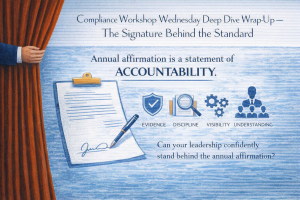
At least once a year, you will be required to affirm that your organization remains compliant. This is not a reflection of what you built. It is a statement about what you have sustained. You are confirming that controls are still implemented, are still functioning as intended, and have been maintained over time.
This is where everything comes together. If your cadence has been consistent, this affirmation is straightforward. If it hasn’t, this is where gaps surface. Not because the organization failed, but because the execution stopped matching the intent.
How Evidence Changes When Cadence Is Real
Before your assessment, evidence is something you actively manage. You gather it, organize it, and prepare it.
After your assessment, evidence should become a byproduct. Tickets reflect real work. Logs reflect real review. Reports reflect real decisions. When cadence is working, evidence builds itself. When cadence breaks down, evidence doesn’t disappear immediately; it degrades.
At first, everything looks fine. Then small gaps appear; a missing review, an outdated report, a control that was implemented correctly but hasn’t been exercised recently. Over time, those gaps tell a different story; not about what your environment was, but what it is right now.
The Real Risk Isn’t Failure. It’s Drift
Organizations rarely fall out of compliance all at once; they drift. A weekly task becomes bi-weekly, a monthly review gets skipped, a quarterly test gets pushed.
Nothing breaks immediately. That’s what makes it dangerous, because by the time an issue becomes visible, it has already been happening for months. Cadence prevents that drift. It creates a structure where controls are exercised often enough that issues surface early. Ownership remains clear even as teams evolve and evidence continues to tell a consistent story over time.
Where This Leaves You
If you passed your assessment, you’ve already proven something important. You can build a compliant environment.
Now the focus shifts; from building to sustaining, from proving once to proving continuously, from urgency to discipline. And at the center of that shift is cadence.
Continuous. Weekly. Monthly. Quarterly. Annually. Each layer matters.
Because together, they answer the only question that really matters in CMMC:
Not “were you compliant?”
But
“Are you still?”
Over the coming weeks, we’ll take a deeper dive into each layer of that cadence, unpacking what continuous, weekly, monthly, quarterly, and annual execution should really look like in practice.
Questions about CMMC certification? Contact Hill Tech Solutions.