Over the course of this deep dive series, we have explored what it takes to sustain CMMC compliance long after the assessment is complete. We discussed continuous operations, weekly validation, monthly accountability, quarterly testing, and annual review activities. Each of these cadences serves a distinct purpose. Each answers a different question about the health and effectiveness of a cybersecurity program. Together, they create a framework for maintaining compliance as an ongoing operational discipline rather than a point-in-time achievement.
Yet there is one final responsibility that brings all these efforts together.
The annual affirmation by the Affirming Official.
For many organizations, the affirmation requirement appears straightforward. A designated company official submits a statement confirming that the organization continues to meet its CMMC requirements. Viewed from a distance, it can seem like an administrative obligation that follows naturally from a successful assessment.
However, our experience taught us something very different.
The affirmation is not merely a procedural requirement. It is the culmination of an entire year of compliance activities, operational discipline, accountability, and evidence collection. More importantly, it represents a personal and organizational commitment to the accuracy of that statement.
The Story
Shortly after completing our assessment, we began planning the years that would follow. We had established our operational cadence, controls were functioning, reviews were occurring, evidence was being collected and retained. Like many organizations, we initially viewed annual affirmation as the final step in an established process. If the controls were operating and the reviews were being completed, the affirmation should be straightforward.
Then a different question emerged during a leadership discussion.
“How does the Affirming Official know the organization remains compliant?”
At first, the answer seemed obvious since the environment had been assessed, the controls had been implemented, and the required activities were occurring. But the more we examined the question, the more significant it became.
An Affirming Official is not simply signing a document because the organization passed an assessment at some point in the past. They are making a formal statement that the organization continues to satisfy the requirements against which it was assessed. That distinction changes everything. The affirmation is not based on assumptions. It is based on the ability to demonstrate that controls remain effective, that responsibilities remain clearly defined, that evidence remains available, and that compliance remains actively maintained.
Once we recognized that reality, the annual affirmation stopped feeling like a standalone requirement. Instead, it became the lens through which we evaluated every compliance activity performed throughout the year.
The Affirming Official
The role of the Affirming Official carries substantial responsibility, as the annual affirmation reflects the organization’s confidence in the effectiveness and sustainability of its compliance program. That confidence cannot be derived from a single annual review. Rather, it must be supported by the collective outcomes of continuous monitoring, weekly validations, monthly oversight activities, quarterly testing exercises, and annual compliance reviews.
Each of these activities provides insight into a different aspect of the environment and, collectively, establishes the evidentiary foundation necessary to support a formal compliance attestation. The Affirming Official relies on all these activities when determining whether the organization is prepared to make a formal compliance assertion.
There is also a legal dimension to this responsibility. The affirmation is a formal attestation submitted to the government, not an internal status update or administrative checkpoint. By affirming continued compliance, the Affirming Official is representing that the organization has implemented and will maintain the applicable CMMC security requirements within the defined assessment scope. That makes the role especially important because an inaccurate or unsupported affirmation can create contractual, regulatory, and potential False Claims Act exposure for the organization.
In many ways, the affirmation is not the beginning or the end of the process. It is the outcome of everything that occurred throughout the year.
The Shift in Thinking
One of the most important lessons we learned was that annual affirmation should not trigger a last-minute scramble for evidence. Organizations that treat affirmation as a once-a-year event often end up rebuilding documentation, validating activities after the fact, and trying to recreate decisions made months earlier. That approach introduces unnecessary risk.
We found it far more effective to embed affirmation into daily operations. Every review, test, corrective action, and ownership discussion served a larger purpose: preserving the evidence and accountability needed to support the eventual affirmation.
That shift changed the questions we asked. Instead of asking only whether a task was completed, we asked whether the results could support an affirmation of compliance. Instead of simply documenting activities, we documented outcomes, decisions, ownership, and corrective actions. Instead of treating evidence as something needed only for an assessment, we treated it as the foundation that allows leadership to make informed decisions with confidence.
These shifts were subtle, but they strengthened our ability to demonstrate compliance over time.
What the Affirmation Really Represents
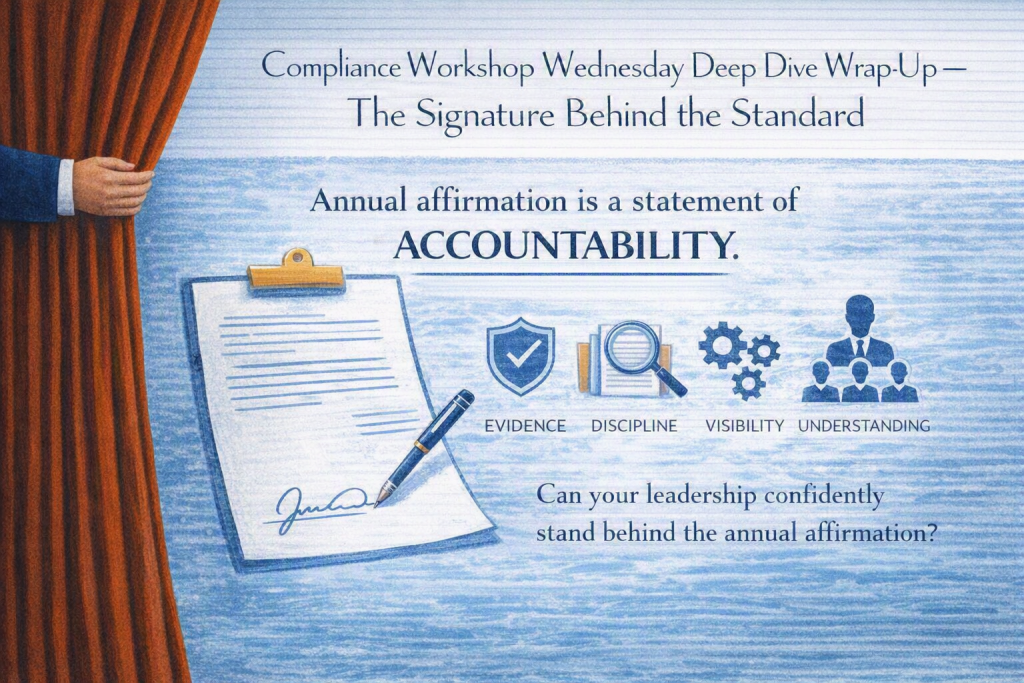
Ultimately, the annual affirmation represents more than compliance. It represents accountability. It shows that leadership has enough visibility into the organization’s security program to make an informed statement about its compliance posture, and it confirms that compliance activities are not performed only because a future assessment may occur.
It also confirms that controls are understood, maintained, reviewed, tested, and supported by evidence throughout the year. Most importantly, it shows that the organization is prepared to stand behind its program and accept responsibility for maintaining it.
That responsibility cannot be fully delegated to tools, consultants, service providers, or compliance platforms. Those resources can support the compliance program, but the affirmation ultimately reflects the organization’s own understanding of its environment and its commitment to maintaining the required standards.
The Final Question That Matters
As we conclude this deep dive series, there is one final question worth considering.
If your Affirming Official had to submit the annual affirmation tomorrow, would it be grounded in evidence they understand or based only on what they believe to be true?
That distinction captures the central theme of everything we have discussed throughout this series:
- Continuous activities provide visibility.
- Weekly cadence provides validation.
- Monthly cadence provides accountability.
- Quarterly cadence provides proof.
- Annual reviews provide verification.
Together, they provide the foundation necessary for an Affirming Official to confidently attest that the organization remains compliant. The annual affirmation is not simply a signature on a form. It is the culmination of a year of discipline, evidence, ownership, and accountability. When viewed through that lens, the affirmation becomes more than a compliance requirement.
It becomes a reflection of whether the organization has truly embedded compliance into the way it operates every day.
Questions about CMMC certification? Contact Hill Tech Solutions.