On July 13, 2026, the Department of War announced the immediate suspension of CMMC Phase II requirements. A few days later, I received a call from a government contractor we’ve been working with for some time. Before we could even get into the details of the announcement, they asked a question I’ve now heard several times.
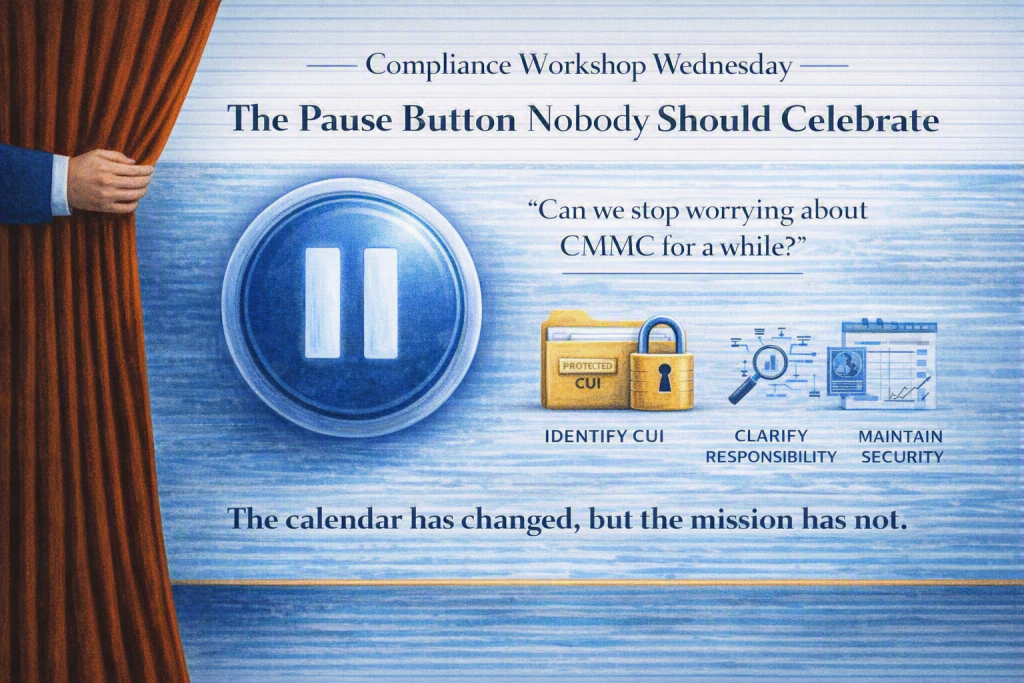
“Ron, does this mean we can stop worrying about CMMC for a while?”
I understood why they were asking. For many small businesses, CMMC has felt like a moving target for years. Between changing timelines, evolving guidance, rising costs, and the challenge of balancing compliance efforts with the day-to-day demands of running a business, a pause sounds like a welcome opportunity to catch your breath. In some cases, it may even feel like permission to put everything on hold.
My answer to that contractor was simple: the pause may change the timeline, but it should not change the work. Contractors should use this period to strengthen their security programs, clarify ownership, and build the operating discipline they will need whether CMMC resumes exactly as planned or returns in a revised form.
The more I thought about that conversation, the more I realized the answer depends on how an organization views CMMC. If CMMC is just a government requirement standing between you and a contract award, a delay may feel like a reason to slow down. If you view it as a framework for building a stronger security program and protecting sensitive information, not much has changed.
That distinction reminded me of something we learned during our own assessment journey. It is easy to treat the assessment as the finish line. We felt that way at times ourselves. But once the assessment was complete, we realized the real goal was building a program capable of sustaining security, compliance, accountability, and operational discipline long after the assessors had left.
That is why I think the conversation around the pause is starting in the wrong place. The real question is not whether the timeline has changed. It is whether the mission has changed. From where I sit, it has not.
What the Pause Actually Means
The last few years have made one thing clear: contractors still face real challenges implementing the requirements tied to DFARS 252.204-7012. The pause does not remove those obligations, so it is worth starting with what the announcement does not change.
It does not mean cybersecurity requirements have gone away. Contractors are still expected to protect Controlled Unclassified Information. NIST 800-171 has not become optional, and organizations cannot ignore security now and expect to be ready when whatever comes next eventually arrives.
What the pause really provides is additional time before third-party assessments may be required. For organizations that have been struggling to gain traction, that time can be valuable if it is used intentionally.
I think about a small manufacturing client I spoke with last year. They had fewer than thirty employees, and everyone wore multiple hats. Their initial reaction to CMMC was not resistance; it was feeling overwhelmed by the scope of what they needed to understand.
They were not asking how to avoid security requirements. They were asking where to begin. That is the reality for many small businesses in the Defense Industrial Base. Extra time can be helpful, but only if it is not mistaken for permission to stop moving forward.
Why CMMC Still Matters
One of the most important lessons we learned during our own journey is that the true value of CMMC has very little to do with the certificate itself.
Certification matters, of course. Contracts may eventually require it, and third-party validation has its place. But what I have always appreciated about CMMC is that it forces organizations to ask questions many have never formally considered.
Where does CUI enter the company? Who has access to it? Which systems process or store it? How do we know our controls are working? If something fails, who owns the fix? If an assessor walked in tomorrow, what evidence would prove we are doing what we claim to be doing? These are not just compliance questions. They are questions about business discipline and leadership.
Over the years, I have met companies that invested heavily in security tools but could not explain where sensitive information resided. I have seen organizations assume their MSP owned compliance because the MSP maintained the firewall. I have seen policies generated and boxes checked without ownership or accountability. The technology was there, but the governance was not.
That is why I often tell clients that CMMC is less about cybersecurity tools and more about operational maturity. The strongest organizations understand their environment, know who owns each responsibility, validate their controls, and maintain evidence that those controls are working. That value does not disappear because the timeline changes.
That also seems to be where the government is leaning. A point-in-time assessment may show readiness on a particular day, but it does not prove an organization can sustain those practices. The larger message is that continuous accountability, repeatable processes, and ongoing evidence are becoming more important, not less.
What CMMC Could Probably Do Without
Whenever I discuss CMMC, someone inevitably asks what I would change if I had the opportunity. My answer is that I would not remove many of the security requirements.
Most practices represent common-sense security controls organizations should already be implementing. Multifactor authentication, access controls, vulnerability management, logging, incident response, and configuration management all serve important purposes. In my opinion, those controls are not the problem.
The challenge is the complexity around implementation and interpretation. Small businesses regularly receive conflicting advice about inherited controls, shared responsibility, acceptable evidence, assessment boundaries, and documentation. I have seen companies ask the same question to three different experts and receive three different answers.
That uncertainty creates frustration because it consumes time, money, and resources without necessarily improving security.
If I could remove one thing from the process, it wouldn’t be a security control. It would be ambiguity.
What the Task Force Should Reform
If the task force truly wants to improve the program, I believe the focus should be on clarity and consistency rather than reducing security expectations.
Small businesses need clearer guidance around inheritance and shared responsibility, practical examples of successful implementation, and more consistent assessment interpretation so different organizations are not receiving dramatically different answers to the same questions.
Most contractors are willing to do the work. What creates frustration is uncertainty. It is difficult to build a plan, allocate resources, establish budgets, and set expectations when the answers seem to depend on who you ask.
The goal shouldn’t be to lower the bar. The goal should be to make the bar easier to see.
The Question Worth Asking
As conversations about the pause continue, contractors should spend less time asking what the government will do next and more time asking whether they would be ready if the pause ended tomorrow.
The pause may have changed the calendar, but it did not change the mission. Contractors entrusted with sensitive information will still be expected to protect it, and the organizations that use this time well will be better prepared for whatever comes next.
What Should Contractors Actually Do During the Pause?
Start by identifying where CUI lives and how it moves through the business. Many organizations discuss compliance for years without clearly mapping the systems, applications, repositories, and workflows that process or store sensitive information. That mapping is the foundation for every meaningful decision that follows.
Contractors should also review their shared responsibility model. Do not assume an MSP, cloud provider, or compliance platform owns requirements that still belong to the organization. Confirm who owns each control, what evidence proves it, and where responsibility is shared rather than transferred.
Finally, build a sustainable operating cadence. Weekly reviews, monthly oversight, quarterly testing, annual assessments, and ongoing evidence collection create accountability that lasts beyond any single deadline.
Use the pause to improve security and reduce risk, not just to meet compliance. If time and resources are limited, focus on work that would still matter if CMMC disappeared tomorrow: improving visibility, strengthening accountability, and protecting sensitive information.
And whether the timeline changes by six months, twelve months, or longer, that objective remains exactly the same.
Questions about CMMC certification? Contact Hill Tech Solutions.