One of the most common questions we hear sounds simple on the surface.
“What does the CMMC journey actually look like?”
Not the diagram.
Not the checklist.
Not the sales pitch.
What does it really feel like from the first conversation to the moment an assessor closes their laptop and says they have what they need?
After going through our own CMMC Level 2 assessment and spending months deep inside the controls, documentation, evidence, and interviews, I can say this with confidence: the journey isn’t mysterious, but it is very different from what most organizations expect.
It’s not a straight line. It’s not fast. And it’s definitely not something you bolt on at the end.
It’s a sequence of moments where assumptions get challenged, clarity slowly replaces uncertainty, and discipline becomes visible.
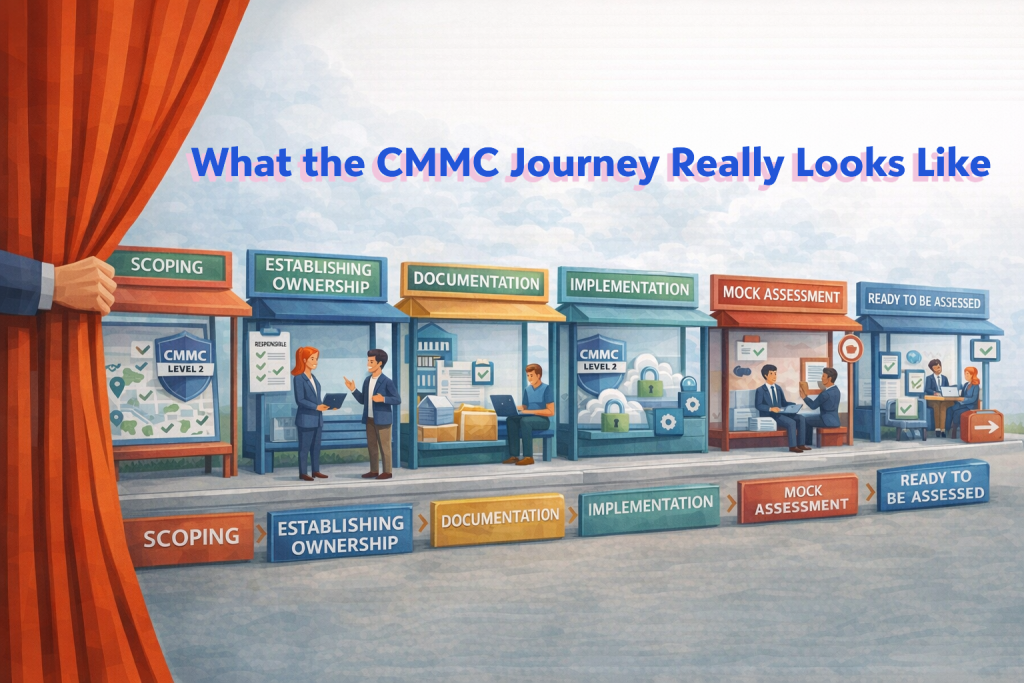
Every journey starts the same way, whether people realize it or not: with scoping.
Scoping is where organizations decide what really matters. Where controlled unclassified information actually lives. Which systems truly touch it. Which users have access today, not which ones are supposed to. This is the point where diagrams meet reality, and it’s often uncomfortable. Not because people did anything wrong, but because few organizations have ever been forced to answer these questions precisely.
When scoping is rushed or treated like a formality, everything downstream becomes harder. Over‑scope and the effort balloons unnecessarily. Under‑scope and confidence quietly turns into risk that doesn’t surface until much later. Done well, scoping creates boundaries everyone can understand and defend. Done poorly, it creates noise that never fully goes away.
Once scope is defined, the next challenge arrives immediately: ownership.
CMMC isn’t interested in who installed a tool or which vendor supports a platform. It’s assessed at the objective level, and that changes the tone of the entire journey. When an assessor asks how something works, the underlying question is almost always the same: who owns this control, who enforces it, and who can prove it?
This is where a lot of journeys either get calmer or more chaotic.
Clear ownership turns the roadmap from theory into action. Assumed ownership creates gaps that stay hidden until assessment prep begins. This is why Customer Responsibility Matrices and shared responsibility models matter so much. Not as documents, but as alignment tools. When responsibilities are explicit, teams know exactly what is expected of them. When they aren’t, remediation always becomes reactive.
Then comes the phase most people underestimate: documentation.
Despite the attention placed on tools and technology, documentation is where most of the time is actually spent. This isn’t busy work. Policies and procedures must align to the assessment objectives, but they also have to reflect how the organization really operates. Not how it wants to operate. Not how it used to operate. How it operates today.
Documentation iterates more than people expect, and that surprises some teams. Controls mature. Edge cases surface. Language that sounded clear at the start becomes ambiguous once systems are live. This isn’t failure. It’s alignment happening in real time. The organizations that struggle are usually the ones trying to force static documentation onto dynamic environments.
Only after documentation and ownership begin to stabilize does technical implementation take center stage.
This is where nuance lives. Every environment has legacy decisions, workflow constraints, and operational realities that don’t show up in templates. Controls don’t drop in cleanly. They change how people work. Access paths shift. Automations fail. Things that quietly “just worked” for years suddenly break under stronger enforcement.
That friction isn’t a sign the journey is going wrong. It’s a sign the controls are becoming real.
Strong change management becomes essential here. Security improvements are rarely invisible, and organizations that expect them to be often lose momentum. The goal isn’t perfection. It’s deliberate progress without losing the business along the way.
As controls settle in, something important starts to shift: evidence stops being theoretical.
In mature programs, evidence isn’t something created for an assessor. It’s a byproduct of operations. Logs are reviewed because someone owns them. Access reviews happen because there’s a cadence, not because someone remembered. Tickets tell a story without needing explanation.
This is the point where compliance starts to feel less like preparation and more like an operating rhythm. When evidence exists naturally, assessment prep stops being a scramble. Conversations become simpler. Requests become predictable.
And then comes the phase many teams are tempted to skip: the mock assessment.
On paper, everything might look complete by this stage. Controls are implemented. Documentation exists. Evidence is being collected. It feels ready. That feeling is precisely why mock assessments matter.
Mocks replace assumptions with proof. They surface where ownership is informal instead of documented. They point out where documentation does not reflect reality. They expose evidence that technically exists but doesn’t tell a clear story on its own. Just as importantly, they prepare people, not systems.
Teams learn how to answer questions clearly and concisely. They learn to provide exactly what’s asked; nothing more, nothing less. That discipline doesn’t come naturally. It comes from practice.
By the time a mock is done properly, confidence feels different; not optimistic but earned.
When the formal assessment finally arrives, the difference is noticeable.
The pace is calmer. Evidence is already organized. Clarifications are incremental, not disruptive. Conversations focus on validation, not discovery. The assessment feels like confirmation of how the organization already operates, not an event that forces change under pressure.
That’s what people miss when they ask what the CMMC journey looks like.
It isn’t about memorizing requirements or buying the right tools. It’s about slowing down enough to understand your own environment, being honest about ownership, documenting reality, and practicing accountability before it matters.
The framework isn’t secret and the roadmap isn’t hidden.
Scope honestly.
Define ownership clearly.
Document the way you actually work.
Implement deliberately.
Treat evidence as an operating output.
Validate with a mock.
Let the assessment confirm the rest.
When those pieces are in place, the journey becomes predictable. Not easy; but calm, defensible, and sustainable.
That’s what maturity looks like.
Stay tuned for next week’s post “Congrats on passing your assessment. Now what?,” where we’ll explore how to maintain your hard-earned compliance, keep momentum going, and ensure your efforts remain resilient as requirements and risks evolve. Stay tuned for practical steps on sustaining success beyond the assessment.
Questions about CMMC certification? Contact Hill Tech Solutions.