There was a point in our CMMC Level 2 journey where everything looked complete on paper.
The controls were implemented. The documentation existed. Evidence was being collected. If you stood back far enough, it felt like we were ready. That feeling is one we see often with customers, and it is where confidence can quietly turn into risk.
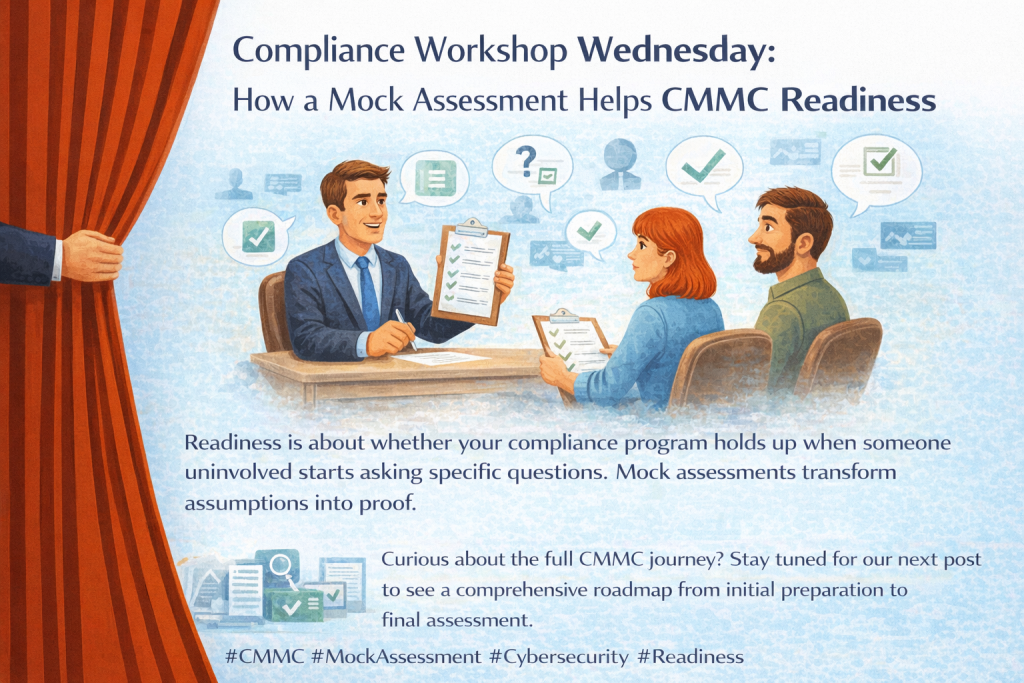
Readiness is not about whether you believe the work is done. It is about whether the work holds up when someone who was not part of building it starts asking specific questions.
That is where the mock assessment came in.
At the time, it would have been easy to skip it. We understood the requirements. We had built environments for customers. We had strong internal discipline. There was no obvious disaster waiting to happen. But compliance rarely fails because of obvious gaps. It fails in the details, in the assumptions, and in the places where intent and execution drift slightly apart.
The mock assessment forced us to stop looking at our program from the inside and see it through the lens of an assessor.
Before the mock even began, another lesson surfaced that we did not fully appreciate at the time. Teams need preparation too, not technical preparation, but mental preparation. People needed to understand that a mock assessment was not a test of intelligence or performance. It was a test of clarity. We spent time explaining what the mock was and what it was not. This was not a pass or fail event. It was a rehearsal. The goal was to surface uncertainty early, not to expose mistakes late.
That framing mattered. When teams understand that the purpose is learning, answers become more honest and gaps surface naturally instead of being hidden behind confidence. People were encouraged to pause, to say, “I need to check,” and to bring evidence forward instead of trying to explain from memory. That mindset set the tone for everything that followed.
Once the mock started, the first difference we felt was the change in posture. The work was no longer about building or improving. It was about explaining. Every control shifted from “we do this” to “show me how you do this and how you know it is working.”
That distinction sounds subtle, but it changes everything.
One of the first challenges that surfaced was ownership. In several areas, enforcement existed, but responsibility was implicit rather than explicit. For example, logging was enabled, logs were retained, and alerts were flowing, but when asked who reviewed them, how often, and where that review was documented, the answer lived across multiple people instead of a single, defensible process. Everyone understood their role informally, but none of that informal understanding counted as evidence.
The mock assessment exposed those gaps immediately. Not because the control was weak, but because ownership had never been written down in a way that aligned cleanly to the assessment objective.
Documentation presented similar challenges. We found policies that were accurate but slightly misaligned with actual practice. In one case, a procedure described a review cadence that had made sense when the document was written but had since evolved operationally. The work was happening, but the documentation told a slightly older story. That mismatch would have triggered questions during a real assessment. The mock gave us a chance to bring the story back into alignment.
Evidence itself was another common friction point. Screenshots existed. Reports existed. Tickets existed. What did not always exist was a clear narrative that tied those artifacts directly to the objective being assessed. During the mock, we encountered moments where evidence was technically correct but required explanation to make sense. If evidence cannot stand on its own without heavy verbal context, it creates risk.
The mock assessment helped us refine how evidence was labeled, stored, and presented so that an assessor could understand the control without needing to fill in gaps mentally.
Another recurring challenge showed up in how people answered questions.
Early on, answers tended to be generous. People wanted to be helpful. They explained background decisions, edge cases, and related controls. The problem is that assessors do not score helpfulness. They score alignment to objective language. In several mock interviews, perfectly good controls became harder to validate because responses wandered outside the scope of the question.
That pattern is incredibly common, and it only becomes visible when teams practice being asked real assessment questions. Over time, answers became tighter, clearer, and grounded in evidence rather than narrative. The discipline to answer exactly what was asked and nothing more is learned, not assumed.
The mock also surfaced operational assumptions that had never been tested under scrutiny. Access reviews were happening consistently, but when asked to demonstrate how exceptions were handled, we realized the process existed verbally but was never documented. Incident response testing plans were solid, but walkthroughs revealed uncertainty around who documented lessons learned and where those records were retained.
None of these issues represented failure. They represented maturity that had not yet been exercised.
The mock assessment provided a safe environment to exercise it.
By the end of the mock, the environment itself had not changed dramatically. What changed was confidence, not the fragile kind built on optimism, but confidence built on repetition and clarity. People knew what assessment questions sounded like. They knew where evidence lived. They knew when to answer directly and when to involve others.
When the real assessment arrived, it felt different because of that preparation. Conversations focused on validation instead of discovery. Evidence requests felt predictable. Clarifications were incremental rather than disruptive. The assessment confirmed what we already understood instead of introducing surprises.
That is the real purpose of a mock assessment. It does not make the work easier. It makes the process calmer, clearer, and more controlled.
In our experience, readiness becomes real the moment assumptions are replaced with proof. The mock assessment is where that transition happens.
Curious about what a full CMMC journey entails? Stay tuned for our next post, where we’ll walk through a comprehensive roadmap—from initial preparation to final assessment. You’ll gain insight into each milestone, common pitfalls, and strategies for success, illuminating the path from uncertainty to certification.
Questions about CMMC certification? Contact Hill Tech Solutions.