Over the last three weeks, we have explored why organizations should govern one compliance program, how one control can support multiple requirements, and why every control needs clear ownership. Supporting several requirements does not automatically satisfy all of them; each requirement still needs its own scope and evidence checked. Once ownership is established, the next question is practical: When does the work happen?
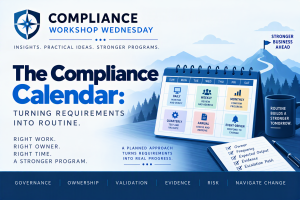
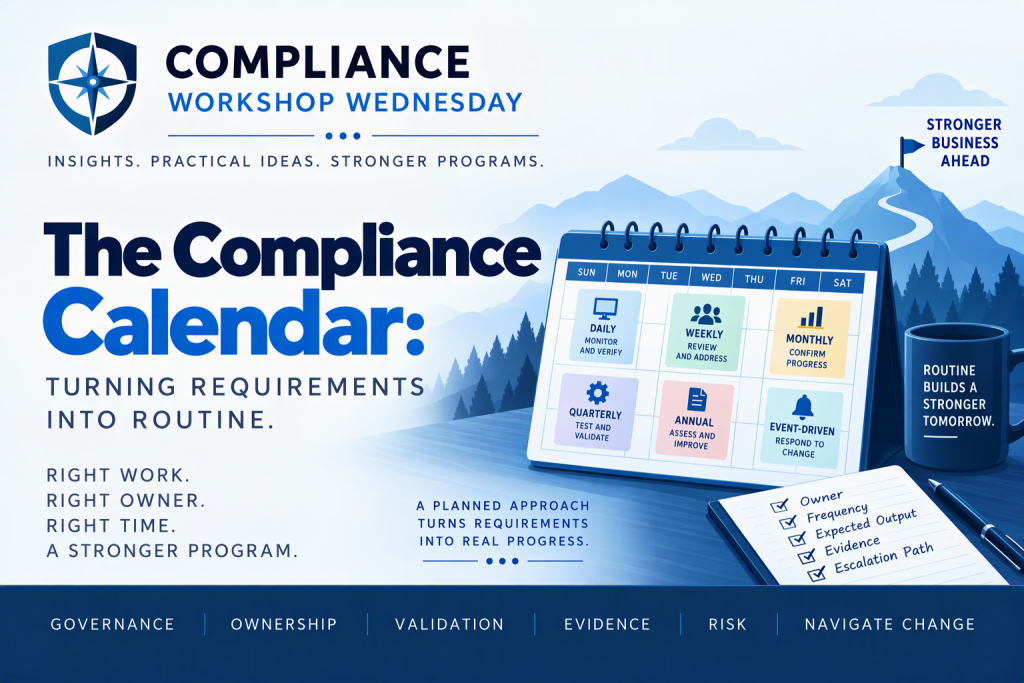
Owners, policies, and procedures define responsibilities, expectations, and methods, but they do not by themselves ensure a reliable operating rhythm. A compliance calendar translates requirements into continuous, weekly, monthly, quarterly, annual, and event-driven activities so the work becomes routine rather than a scramble before an assessment. The intervals in this article are illustrative, not universal requirements. Use the deadlines and frequencies required by applicable obligations and use level of risk to guide scheduling where those obligations allow discretion.
A Requirement Is Not Yet a Routine
Frameworks describe expected outcomes, policies establish commitments, and procedures explain the work. These sources may already specify a frequency, deadline, or triggering event. The organization still needs to translate those expectations into assigned, scheduled activities and define timing wherever the requirements leave it open.
A policy requiring periodic access reviews leaves important questions unanswered: How often? Which systems? Who starts the review, resolves excessive access, and retains the records?
The same gap affects vulnerability remediation, backup testing, training, incident exercises, vendor reviews, risk reassessments, and policy updates.
Without a repeatable schedule, these responsibilities depend on memory, available time, or an approaching assessment. Good intentions are not an operating model. The calendar closes the gap between an expectation and an activity someone can carry out. Instead of leaving “periodically” open to interpretation, it establishes a shared understanding of when the work is due and how the organization will know it happened.
One Calendar Creates Visibility
A master compliance calendar brings recurring activities into one coordinated view. It need not be complicated; it must make responsibilities, deadlines, and missed work visible.
Each entry should identify the owner, frequency, systems or processes in scope, expected output, evidence location, and escalation path.
A quarterly access review entry, for example, should identify the applications covered, who produces reports, who reviews permissions, when findings must be resolved, and where approvals and remediation records are retained. Those details turn a reminder into a governed activity.
A shared view also reveals workload bottlenecks. Distributing reviews, tests, training, and assessments across the year avoids concentrating everything in the final month. Reviewing the workload with activity owners also makes the schedule more realistic. A calendar that looks organized but cannot be sustained does not solve the underlying problem. The people producing reports, reviewing results, and resolving findings need to understand how their work fits together.
Continuous Activities Keep Controls Operating
Security monitoring, alert triage, endpoint protection, log collection, backups, identity enforcement, configuration monitoring, and vulnerability detection may operate continuously.
Continuous does not mean unattended. Someone must verify that systems work, alerts reach the right people, failures are investigated, exceptions are documented, and evidence is retained. Automated controls can fail quietly without oversight.
The calendar should therefore include recurring validation. Backups might run nightly, with success reviewed weekly and restoration tested quarterly. Automation changes how a control operates, not the need to govern it. These are related responsibilities, but they answer different questions. Running the job shows that an activity occurred; reviewing its status checks whether it succeeded; testing restoration examines whether the result serves the business. The calendar should make each responsibility visible rather than treating automation as proof that everything works.
Weekly Reviews Catch Problems Early
Weekly reviews address operational problems that should not wait until the month-end. Depending on the organization, these may include failed backups, overdue patches, unresolved vulnerabilities, account and privilege changes, incidents, exceptions, and compliance tickets.
The purpose is to catch problems while they remain manageable, not simply to hold another meeting. A failed backup can be corrected, excessive permissions removed, and stalled remediation escalated before small issues become larger gaps. A focused review should connect the issue to the person responsible for addressing it and make unresolved work visible. Otherwise, the same problem can appear week after week without a clear outcome. The value comes from follow-through, not from repeatedly acknowledging that an issue exists.
Monthly Activities Confirm the Process Is Working
Monthly reviews examine whether recurring processes are working. Activities might include reviewing access, remediation progress, endpoint coverage, configurations, training completion, evidence repositories, exceptions, policy acknowledgments, or third-party reports.
Frequency should reflect risks, technologies, contracts, and framework obligations. The goal is not to make every control monthly, but to match its importance and rate of change.
A dynamic environment may require frequent access reviews, while a stable system may need fewer formal reviews. Critical vulnerabilities may demand immediate action rather than a scheduled review. The calendar should reflect how the organization actually manages risk.
Quarterly Activities Test More Than Completion
Quarterly activities test effectiveness beyond daily operations. Examples include restoring backups, exercising incident response, testing access changes and alert escalation, reassessing risks, reviewing vendors and exceptions, and reporting program health to leadership.
Completion alone is not enough. Can data be recovered within business requirements? Do employees understand their incident response roles? Can any accounts or processes bypass multifactor authentication? Testing produces evidence while exposing assumptions that need correction. The distinction matters because a completed task and an effective control are not always the same thing. A review can be recorded without resolving the problem it uncovered. The calendar should connect testing with findings, corrective work, and retained evidence so the organization can demonstrate more than participation.
Annual Activities Look at the Entire Program
Annual activities evaluate the broader program through risk assessments, policy and management reviews, effectiveness evaluations, attestations, formal training, framework reassessments, and external assessment preparation.
The annual review should build on existing evidence, not reconstruct a year of unfinished work. Leadership should examine trends, unresolved risks, repeated failures, aging exceptions, organizational changes, and investment needs. This is when the organization evaluates the program it has operated all year—not when compliance begins. This view also puts individual activities in context. A recurring failure or an exception that remains open may deserve more attention than a calendar full of completed tasks suggests. Leadership needs to understand what the accumulated results say about the program.
Some Activities Are Triggered by Events
Some activities follow business changes rather than fixed dates. Departures trigger access removal and equipment recovery; new hires trigger provisioning, training, and policy acknowledgment. New systems may require risk reviews, security configuration, data classification, vendor assessment, and documentation updates. Other triggers include incidents, acquisitions, new offices, major configuration changes, contracts, regulatory obligations, and provider changes.
Define each trigger, required actions, owner, completion timeframe, and retained evidence. Event-driven activities keep the program aligned with the business instead of allowing documentation and controls to fall behind. Although the date is unknown, the response should not be improvised. Defining the work in advance gives the owner a clear starting point when the event occurs and establishes what completion should look like.
Start With the Activities That Matter Most
Start with activities that protect your most important systems, information, customers, and contractual obligations. You do not need to schedule every requirement immediately.
For each activity, define what must happen, who owns the outcome, who performs the work, and its frequency or trigger. Establish how completion is verified, what evidence is produced, where it is retained, and who is notified when work is missed.
Place activities into the appropriate cadence and review the calendar with those doing the work. Confirm that schedules are realistic, ownership is understood, and completion can be demonstrated. The goal is a sustainable operating rhythm, not a calendar for its own sake. As you review the calendar, distinguish accountability for the outcome from responsibility for individual steps. The owner may depend on others to supply reports, approve decisions, or resolve findings. Making those connections explicit helps ensure that an entry represents a workable process rather than a deadline assigned to one name.
Routine Is What Makes Compliance Sustainable
When compliance depends on memory, teams scramble for evidence and reviews happen inconsistently. A calendar replaces that uncertainty with routine: responsibilities have owners, activities have a cadence, evidence has a home, and missed work becomes visible.
This week, identify five recurring activities and establish their owners, frequency, evidence, and escalation paths. If an activity exists only in a policy or someone’s memory, put it on the calendar. Compliance isn’t something you finish. It’s something you govern.
Up Next: November 18
Evidence Should Be a Product of the Process
In the November 18 installment, we will explore how processes can naturally produce and retain screenshots, tickets, approvals, logs, and review records as work occurs, rather than requiring a scramble before an assessment.
Questions about certification, compliance or governance? Contact Hill Tech Solutions.