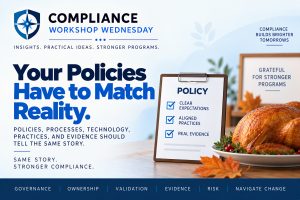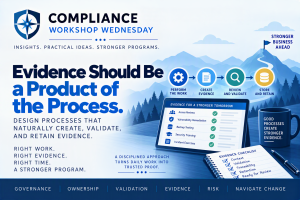
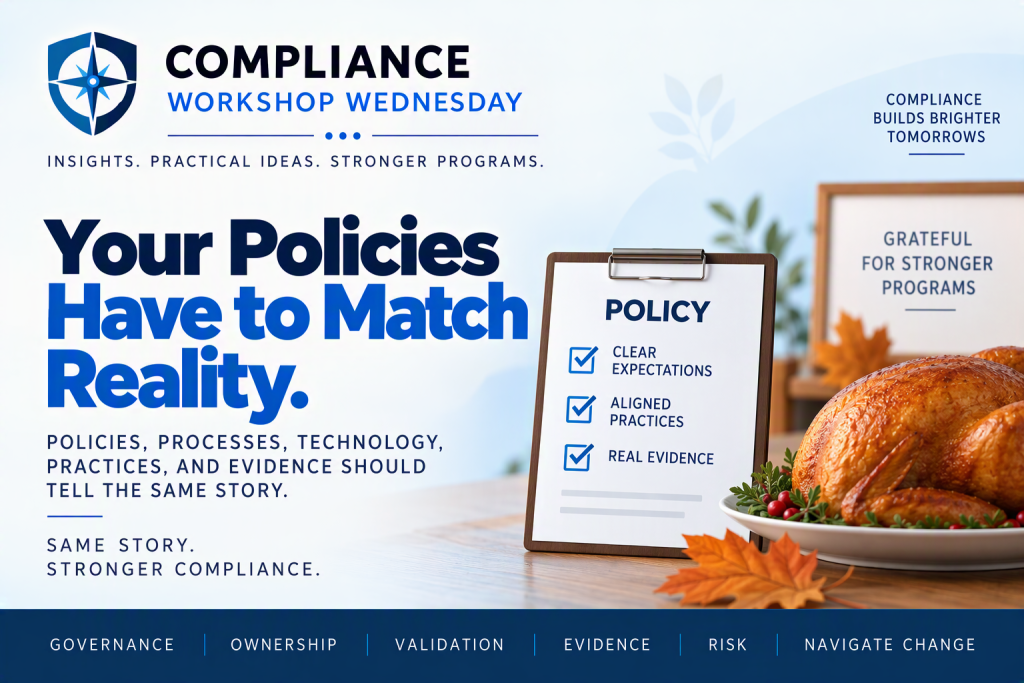
Tomorrow is Thanksgiving and a good moment to be thankful for the compliance work already in place. Over recent weeks, we have covered one compliance program, common controls, ownership, a compliance calendar, and processes that create evidence. Those elements should now connect to the policies that explain what the organization requires and how work is performed.
That connection is often weaker than assumed. Like a family recipe tweaked over the years, a policy may have come from an implementation project, a template, a prior provider, or a rushed pre-assessment update. Meanwhile, technology changes, responsibilities move, and teams develop their own practices. Eventually, the document and the operating environment describe two different organizations.
A policy is not accurate simply because it is approved, and a process is not compliant simply because people believe it works. Policies, standards, procedures, technology, practices, and evidence should tell the same story. When they do not, the mismatch creates confusion, weakens accountability, and turns a risk-reducing document into a risk.
The Compliance Document Nobody Reads Until the Assessment
Many policy problems stay hidden because the document is rarely used after approval. Employees acknowledge it once a year, leadership approves revisions, and the file sits untouched until a customer, auditor, assessor, or insurer asks for it. Then someone reads it closely and finds statements that no longer match reality.
A policy may require quarterly access reviews when they happen annually. It may say logs are reviewed daily when the managed service provider reviews alerts continuously and sends a weekly summary. It may assign duties to a role that no longer exists or name a retired system. None of these necessarily means the control is ineffective, but each raises the question of which version to trust.
The question gets harder when documents conflict. A policy may require one approval path, a procedure another, a ticketing workflow a third, and employees an informal fourth. During an assessment, the organization must explain why its commitments, technology, and records do not align. It is better to correct these differences during normal governance than while a reviewer waits.
Policy, Standard, Procedure, Technology, and Evidence
A useful way to evaluate alignment is to follow the chain from policy to evidence. The policy states intent and mandatory direction. A standard defines required rules. A procedure explains how people perform the activity. Technology supports or enforces it. Evidence shows what actually happened.
Consider vulnerability management. The policy requires risk-informed remediation. A standard defines severity categories, review periods, remediation targets, and exception conditions. The procedure explains how scan results are reviewed, tickets assigned, and overdue issues escalated. Scanning and ticketing platforms support the workflow, and reports, remediation records, and exception decisions are the evidence.
If the policy promises remediation of every critical vulnerability within a fixed period, but the standard allows no exceptions and evidence shows repeated overdue items, the story breaks down. The answer is not to weaken the policy until it says nothing. The organization should decide whether the requirement is appropriate, whether the process needs improvement, whether exceptions need governance, and whether leadership understands the accepted risk.
Read the Story in Reverse
The chain should also work in reverse. Start with the evidence and ask what process produced it. Then confirm that the procedure describes that process, the standard sets the rules, and the policy supports the commitment.
Reverse review is valuable because documents often describe an idealized process while evidence reveals the real one. A completed access review shows who generated the user list, who reviewed it, and when changes were closed. If the procedure assigns those steps differently, the practice, the procedure, or both need to change. Evidence is not automatically correct, but it is a direct view of what occurred.
Be cautious about resolving every discrepancy by rewriting the document to match current behavior. Sometimes the behavior is the problem. If employees bypass approvals or terminated accounts stay active, the policy may be correctly identifying an obligation the process fails to meet. Governance means deciding which element must change and verifying the result.
Write Policies the Organization Can Govern
Strong policies are specific enough to set direction and accountability without becoming fragile operating manuals. A policy should state what is required, who is accountable, what is in scope, how exceptions are governed, and how compliance is reviewed. System steps and field names belong in procedures because they change more often.
Overly vague policies create a different problem. Statements such as “appropriate security will be maintained” or “access will be reviewed regularly” set no clear expectation. Standards should define what appropriate means, and recurring reviews need a meaningful frequency or trigger. Flexibility should come from governed standards and exceptions, not language that avoids commitment.
Templates are helpful starting points, but every statement must be validated. A store-bought pie is fine until someone claims it is homemade. If a template mentions a security operations center, data loss prevention platform, or committee the organization lacks, those references should not stay because they sound mature. A shorter, accurate document beats an impressive one describing someone else’s program.
Make Document Review Part of the Operating Rhythm
Annual review may not keep documents aligned with a changing environment. Significant events should also trigger review, such as replacing an identity provider, changing an MSP, adopting a cloud platform, restructuring responsibilities, acquiring a company, changing a contractual obligation, or adding a new type of regulated data.
The compliance calendar should include both scheduled and event-driven reviews. The owner should confirm that scope is accurate, named roles exist, referenced systems are current, frequencies match the calendar, and evidence supports the stated process. Review should involve the people who do the work, since operators often spot outdated instructions first.
Approval is the final step, not the whole review. A meaningful review records what changed, why, who evaluated the operational impact, whether training is needed, and whether related procedures, configurations, or evidence requirements must also change.
Start With Five Documents and Five Records
You do not need to rewrite the whole policy library at once. Select five important documents, such as access control, vulnerability management, incident response, backup and recovery, and security awareness. For each, take a recent set of operating records and compare the written requirement to what the evidence shows.
Ask whether the owner is correct, the scope covers the relevant systems and people, the frequency matches the calendar, the procedure matches the workflow, the technology supports the requirement, and the evidence shows follow-through. Document each mismatch and decide whether to update the policy, change the process, adjust the technology, clarify ownership, govern an exception, or improve the evidence. Then assign and verify the correction.
The goal is not perfect wording. It is an operating program that explains itself consistently, without four versions of the truth.
The Documents Should Describe the Program You Actually Operate
Policies communicate expectations, support accountability, and create commitments that customers, regulators, assessors, insurers, employees, and leadership may rely on. Accuracy therefore matters more than polish. A beautifully presented policy no one follows is like a holiday table that looks perfect but was never cooked from the real recipe: a warning that documentation and operations have separated.
After the holiday, choose five policies and compare them with five recent records from the related processes. Follow the story forward from policy to evidence and backward from evidence to policy. Where it changes, decide whether the document or the operation needs correcting, and bring them back together. Your policies should describe the program you govern today, not the organization you intended to build three years ago. Compliance isn’t something you finish. It’s something you govern.
Thank you for reading and for your continued commitment to building a compliance program you can stand behind; we wish you and your team a safe and happy Thanksgiving.
Up Next: December 2
Every Change Is Potentially a Compliance Change
In the December 2 installment, we will look at how new technology, providers, locations, employees, processes, acquisitions, and other significant changes affect controls, risks, documentation, evidence, and obligations, and why a compliance impact review belongs in normal change management.
Questions about certification, compliance or governance? Contact Hill Tech Solutions.