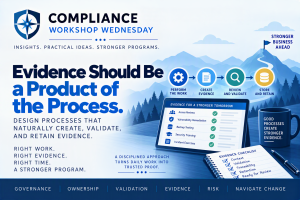
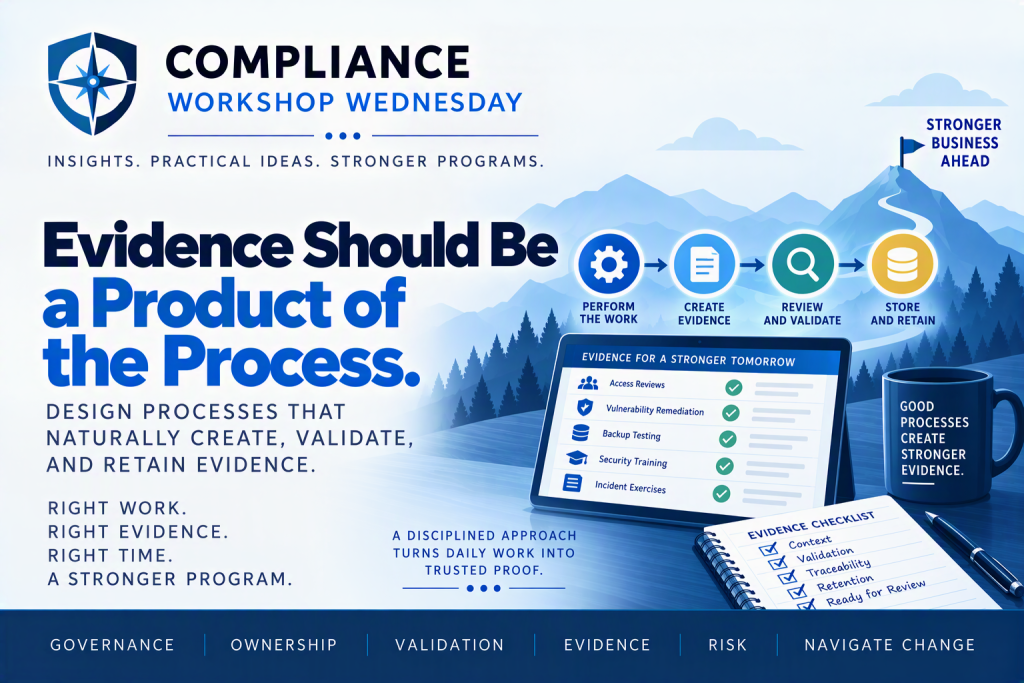
Evidence is strongest when the process itself creates it. Over four posts, we have covered governing one compliance program, using common controls for multiple requirements, assigning clear ownership, and building a practical compliance calendar. Those elements create structure, but raise the next question: what proof does the process leave behind when the work is performed?
Many organizations wait until an assessment, customer review, or renewal questionnaire to ask what evidence they need. By then, teams are searching inboxes, recreating screenshots, exporting reports, and asking people to recall events from months earlier. That effort is expensive, disruptive, and often incomplete. A better approach is to build each process so it creates and retains useful evidence as part of the normal work.
In short: good evidence is created by the process, not collected for the assessment; it needs context and validation to be trusted; and it should be stored and verified on the compliance calendar so gaps surface early.
Evidence Is More Than a Screenshot
Evidence demonstrates that a requirement was implemented and that the related control operated as intended. A screenshot may help, but it often captures only a moment in time. It may show that a setting exists without showing who approved it, how long it was active, whether exceptions were reviewed, or what happened when the control failed.
Good evidence tells a fuller story. An access review may produce a system-generated user list, a reviewer’s approval, tickets for permissions that must be removed, confirmation that those changes were completed, and a record showing when the review closed. Together, those records demonstrate both the review and the organization’s response to its findings. The objective is not to accumulate files. It is to preserve reliable proof of the activity, the decision, and the outcome.
Start With the Process, Not the Assessment Request
Assessment preparation often begins with a list of requested artifacts. That list is useful, but it should not become the operating model. If the team asks, “What file can we provide?” it may choose something that looks relevant without proving the control worked. The better question is, “What should this process naturally produce when it operates correctly?”
Vulnerability management might produce scan results, risk-based prioritization, remediation tickets, exception approvals, and validation that the issue was resolved. Security awareness training might produce training assignments, completion status, reminders, escalation records, and follow-up for employees who missed the deadline. Backups may produce job status, failure alerts, investigation tickets, restore-test results, and approval of corrective actions. Each record exists because someone performed or reviewed the work, not because an assessor asked for a document.
Design Evidence Into the Workflow
Evidence should be defined when the control and its procedure are designed. For every recurring or event-driven activity, identify the expected output, the system that creates it, the person responsible for reviewing it, the retention location, and the escalation path when the expected record is missing. These decisions turn evidence from an afterthought into a managed part of the process.
Use the systems where the work already occurs. A service ticket can capture assignment, timestamps, notes, approvals, attachments, and closure. An identity platform can produce access and authentication reports. A learning platform can retain training history. A security tool can record alerts, acknowledgments, investigations, and remediation. A governance platform can link an artifact to a control, owner, review period, and requirement mapping. The right repository will vary, but each record should stay traceable to the work that produced it.
Evidence Needs Context
A technically valid record can still be weak evidence if no one can explain what it represents. A spreadsheet of accounts without the system name, review period, reviewer, decision, or resolution status forces someone else to reconstruct the meaning. The same problem occurs when screenshots have no date, reports use unexplained filters, or ticket exports omit the final disposition.
Each evidence package should answer several basic questions: What activity occurred? What systems, people, or data were in scope? Who performed and reviewed it? When did it happen? What criteria were applied? What exceptions or failures were found? How were they resolved or accepted? Where appropriate, a short review record or ticket summary can provide this context without creating a separate narrative for every artifact. The goal is for another qualified person to understand the evidence without relying on the memory of the person who collected it.
Collection Is Not the Same as Validation
Automatically saving reports is helpful, but collection alone does not prove that a control is effective. A monthly report may show that endpoint protection is deployed yet also reveal devices that have stopped reporting. A backup log may show successful jobs, but only a restore test can demonstrate that usable data can be recovered. An access review may be marked complete even though identified permissions remain unchanged.
The process must include review and follow-through. Evidence should show that someone evaluated the result, addressed failures, documented exceptions, and confirmed closure. This distinction is important because a large evidence library can create false confidence. The strongest programs do not merely retain records of activity. They retain records of oversight, decisions, corrective action, and validation.
Make Evidence Easy to Find and Trust
Evidence loses value when it is scattered across personal inboxes, local folders, temporary links, and systems that no longer retain historical data. Organizations should establish a consistent structure for naming, storing, protecting, and retaining evidence. That structure should reflect the control or process, the period covered, the system in scope, and the review status. Access should be limited based on sensitivity, while still allowing the people responsible for governance and assessment preparation to retrieve what they need.
Version control and integrity also matter. Teams should be able to distinguish an original system record from a summary prepared later, identify who approved a decision, and determine whether an artifact was altered. Retention must align with applicable contractual, legal, regulatory, and business requirements. More is not always better. Keeping unnecessary sensitive data increases exposure, while deleting required records too early creates a different risk. Evidence governance should balance availability, integrity, confidentiality, and retention.
Use the Calendar to Confirm Evidence Exists
The compliance calendar introduced earlier in this series should not only schedule the activity; it should also schedule confirmation that the expected evidence was created and retained. A monthly access review is not complete when the meeting ends. It is complete when the review record exists, required changes are assigned, remediation is tracked, approvals are captured, and the final package is stored in the agreed location.
Periodic evidence reviews can identify broken processes before an assessment does. Missing reports may reveal a disabled integration. Incomplete tickets may show that closure criteria are unclear. Repeated screenshots may indicate that a manual process should be automated. Evidence quality is therefore more than an assessment concern. It is feedback about whether the underlying process is dependable and sustainable.
Start With Five Important Processes
You do not need to redesign every control at once. Select five important processes such as access reviews, vulnerability remediation, backup testing, security training, and incident response exercises. For each one, document the activity, expected evidence, source system, owner, reviewer, retention location, and response when the evidence is missing or shows a failure.
Then run the process and inspect what it actually produces. Can another person understand the records? Do they show scope, timing, review, decisions, and follow-through? Can the organization retrieve them without depending on one employee? If the answer is no, improve the workflow now, while the activity is still recent. Small improvements made during normal operations are far less disruptive than reconstructing months of history under an assessment deadline.
Proof Should Follow the Work
A sustainable compliance program does not treat evidence collection as a separate event. The process itself creates the record, the owner confirms its quality, the repository preserves it, and the calendar verifies that nothing was missed. When those elements work together, assessment preparation becomes a review of an operating program rather than a search for proof that may or may not exist.
This week, choose five recurring activities and identify the evidence each one should naturally produce. If the evidence requires a special scramble, redesign the process so proof follows the work. Do not collect evidence only for the assessment. Design processes that create evidence. Compliance isn’t something you finish. It’s something you govern.
Up Next: November 25
Your Policies Have to Match Reality
In the November 25 installment, we will examine why policies, procedures, technology, day-to-day practices, and evidence must tell the same story, and what happens when the compliance document nobody reads until the assessment no longer matches the organization.
Questions about certification, compliance or governance? Contact Hill Tech Solutions.