Over the last two weeks, we explored governing a compliance program rather than managing separate frameworks, and using one control across frameworks. Reuse still depends on each framework’s scope, requirements, and evidence expectations. Both ideas raise a question: Who owns this?
A policy, platform, or spreadsheet does not own a control. Hiring a consultant, MSP, MSSP, or managed compliance provider does not transfer ownership. A person or accountable business function must ensure the control works consistently and produces evidence.
Documenting what should happen is easier than establishing who keeps it happening, notices failures, corrects problems, and retains proof. Compliance without ownership eventually becomes compliance by assumption.
A Control Can Exist Without Being Governed
Consider employee offboarding. The policy may say user access must be removed when an employee leaves. HR updates the HR system. IT disables accounts. The manager transfers responsibilities and company property. Security may verify that privileged or sensitive access was removed.
Everyone understands part of the process, but that does not mean anyone owns the whole outcome. Who makes sure HR notifies IT at the right time? Who checks applications outside centralized identity management? Who documents exceptions? Who retains evidence that everything happened?
If the answer is simply, “IT handles it,” ownership probably is not clear enough. IT may operate parts of the process, but operating technology is not the same as owning the business process or being accountable for the risk. A control needs accountability for the outcome.
Ownership Has Layers
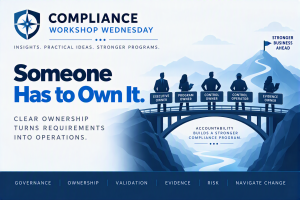
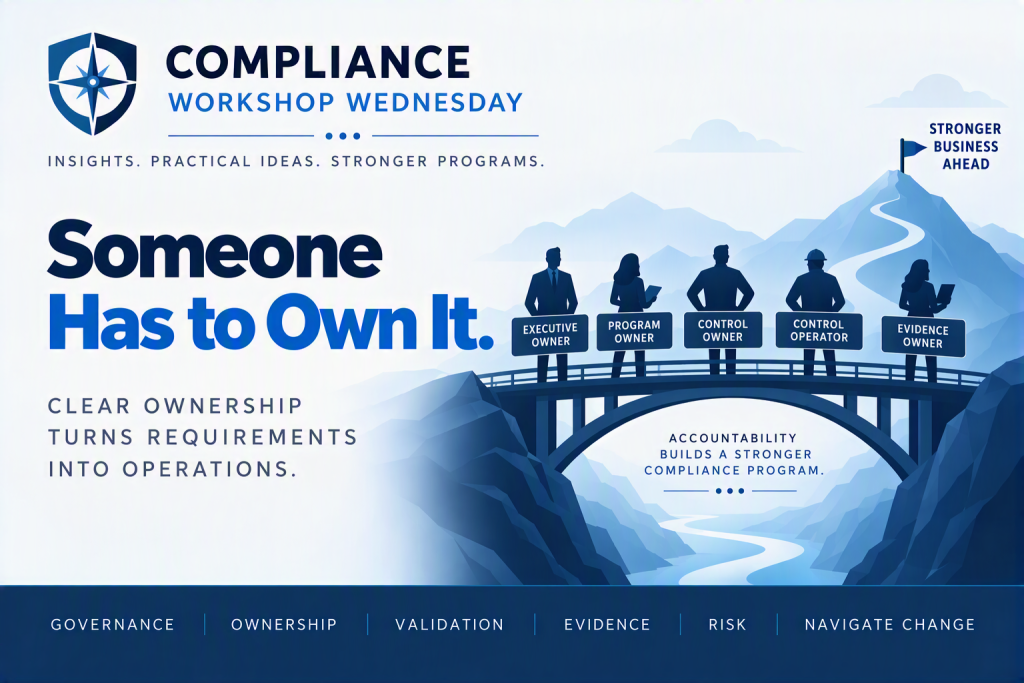
One practical way to make ownership easier is to stop treating it as a single responsibility. For many controls, ownership has layers: Executive Owner, Compliance Program Owner, Control Owner, Control Operator, and Evidence Owner.
The goal is clear responsibility, not more titles. In a large organization, those responsibilities may sit with different people or departments. In a small or midsized business, one person may fill several roles, provided that arrangement preserves any required separation of duties or independent review. Either model can work within those boundaries.
The executive owner provides organizational accountability and ensures the program has authority, resources, and leadership attention. The compliance program owner coordinates obligations, issues, and dependencies. The control owner is accountable for whether a specific control is effective and should understand what it accomplishes, where it applies, how it operates, what could cause it to fail, and how effectiveness is validated.
The control operator performs the activity. That might mean IT creates an account, HR starts an offboarding workflow, a manager approves access, or security reviews an alert. The evidence owner ensures the organization can prove the activity occurred through tickets, approvals, logs, reports, or review records, rather than screenshots collected right before an assessment.
Several of these responsibilities may belong to the same person. That is not the problem. The problem is when an important responsibility exists and nobody realizes they own it.
Responsibility Cannot Live Only in a Policy
One mistake we often see is confusing documented responsibility with actual accountability. A policy might say access will be reviewed periodically, but someone still needs to decide which systems are included, produce the access information, review permissions, follow up on excessive access, approve exceptions, and confirm the review was completed.
If the organization cannot answer those questions, it does not really have an access review process. It has a sentence describing one. Eventually, when someone asks for evidence, the organization discovers the process everyone believed existed was not operating consistently. That is not primarily a documentation failure. It is an ownership failure.
Technology Doesn’t Own the Control
Technology can create the same confusion. Organizations invest in platforms for multifactor authentication, endpoint protection, vulnerability management, logging, backup, email security, identity management, and other important capabilities. Over time, the presence of the tool can be mistaken for the operation of the control.
A vulnerability scanner may identify vulnerabilities, but it does not own vulnerability management. Someone still needs to review findings, determine priority, assign remediation, manage exceptions, verify corrections, and decide what happens when an issue cannot be resolved immediately.
The same applies elsewhere. A backup platform may perform backups, but it does not decide recovery requirements or whether a restoration test was successful from the business’s perspective. An identity platform can enforce permissions, but it does not decide who should have access. A monitoring platform can generate alerts, but it does not own incident response decisions.
Technology enables controls, but people and processes govern them. Someone must confirm the technology is configured appropriately, remains operational, exceptions are handled, effectiveness is validated, and evidence is retained.
Outsourcing Doesn’t Eliminate Ownership
Outsourcing can give smaller businesses expertise and capacity they lack internally to operate platforms, monitor alerts, interpret requirements, and perform reviews.
But outsourcing an activity does not automatically outsource accountability. If your MSP manages user accounts, someone inside the organization still needs to define who can approve access. If a managed security provider monitors alerts, the organization still needs to know who makes business decisions during escalation. If a provider performs backups, somebody needs to understand the recovery requirements and whether the service meets the business need.
This is where shared responsibility needs to be specific. Rather than asking, “Does our provider handle this?” ask what the provider performs, what remains internal, who owns it, how performance is validated, and what evidence is retained.
Ownership Has to Survive Organizational Change
There is another reason clearly assigning ownership matters: people change. Employees leave, managers get promoted, IT responsibilities move, service providers change, and organizations restructure. A process that works only because one person remembers it every month is not sustainable.
That arrangement can work for years, right up until the person who owns that knowledge changes roles or leaves. Suddenly, the monthly access review stops happening; an exception is not revisited, evidence is no longer saved, or nobody realizes a recurring compliance activity has been missed.
A well-governed control should survive the person currently performing it. The responsibility should be defined, the cadence established, and someone should know when the activity does not occur. Clear ownership usually reduces complexity because people no longer have to guess who is responsible.
Five Questions That Make Ownership Practical
Organizations do not need to turn ownership into another massive compliance project. Start with the most important controls and ask five questions: Who is accountable for the control? Who performs the activity? How often, or under what circumstances, does it occur? Who verifies that it worked? Where is the evidence?
Those questions sound basic, but they reveal a lot about program maturity. Clear answers identify the accountable person or business function, explain who performs and verifies the activity, establish its timing, and locate the evidence. Answers such as “IT,” “our MSP,” “automatically,” or “we think we have that somewhere” may describe part of the arrangement, but they do not answer all five questions. If that is where the explanation stops, there is probably more work to do.
That is not a bad thing. Good governance is not about pretending everything is perfect. It is about making responsibilities, dependencies, and gaps visible enough to manage intentionally. Finding unclear ownership during an internal review is far better than discovering it during an assessment or after an incident.
Ownership Is What Turns Requirements Into Operations
This brings us back to the larger idea behind this Compliance Workshop Wednesday series. Frameworks define expected outcomes. Policies describe what the organization intends to do. Technology enables controls. Consultants and service providers supply expertise and operational support. None of those things replaces accountability.
Someone needs to make sure the control remains appropriate as the organization changes, operates on the expected cadence, and produces evidence. Someone also needs to ensure problems are corrected, exceptions are managed, and risks are understood when things do not happen. That accountability moves compliance from documentation into operations.
As you look at your own compliance program this week, pick a few important controls and ask the simplest question you can ask: Who owns this? Keep asking until the answer identifies an actual person or accountable business function and everyone involved understands what that ownership means. If three people point at each other, you just found something worth fixing.
Because compliance isn’t something you finish. It’s something you govern.
Questions about certification, compliance or governance? Contact Hill Tech Solutions.