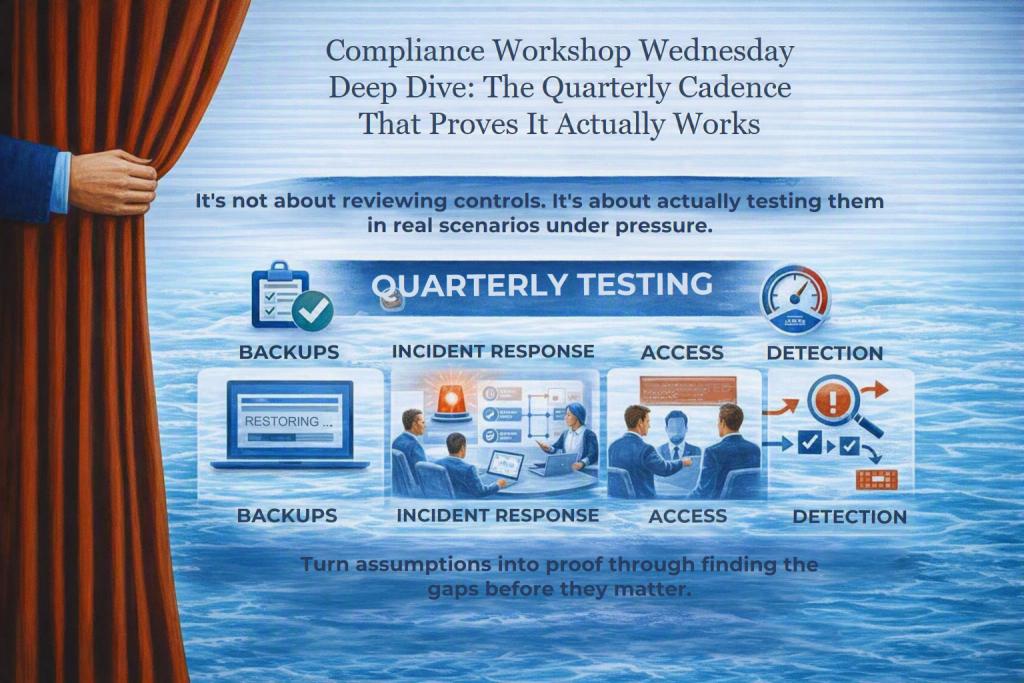
Quarterly cadence is where confidence gets tested. It is the point where organizations move beyond reviewing controls and start proving that they actually work under real conditions. This is the layer that turns assumptions into evidence and shows whether your environment will hold up when it matters most.
The Story
By our first real quarterly review after the assessment, things felt steady. Our weekly rhythm was in place, and monthly reviews were reinforcing ownership, access validation, exception reviews, and control alignment.
If someone had asked whether our controls were running and aligned, the answer would have been yes. Then someone asked the question that shifted everything: when had we last proven they would really work?
Until then, our work showed the environment looked right, but not what would happen under pressure. That is where quarterly cadence stopped being theoretical and became necessary.
We started with backups. Instead of looking at reports showing successful jobs, we chose a real system and asked someone outside of the backup process to restore it. On the surface, everything was completed as expected, but when we walked through the full recovery, gaps became obvious. The process was not clearly documented for someone unfamiliar with it, and the restored data required more effort than anticipated to be usable. That exercise forced us to formalize something we had not been doing consistently, selecting critical systems each quarter and validating full restoration, documenting the steps, and confirming that someone other than the primary owner could complete the process without guesswork.
That experience changed our perspective. Backups do not prove their value when they run successfully; they prove their value when they are tested and relied upon.
Next, we turned to incident response. We had a documented plan that appeared complete, and everyone knew where to find it. To test it, we ran a tabletop exercise based on a realistic scenario involving suspicious activity tied to sensitive data. Initially, the team followed the expected flow, but as the exercise progressed, uncertainty began to surface around escalation, communication, ownership, and real-time tracking. That exercise turned into a quarterly requirement for us. Each quarter, we now run a scenario, walk through roles and decisions, and capture what worked, what did not, and what needs to change so that the next response is faster and more precise.
Again, nothing was broken. However, the difference between knowing a process exists and proving that it works became very clear.
From there, we expanded our testing to access controls. Rather than reviewing permissions conceptually, as we did during monthly reviews, we tested real scenarios such as user termination and role changes. We traced what happened to that user’s access across systems and measured how quickly and completely it was removed or adjusted. That led us to incorporate quarterly validation of identity lifecycle controls, ensuring that onboarding, role changes, and offboarding behave consistently across all systems, including the ones that depend on manual processes or exceptions.
We also validated detection and response by simulating alerts and following them through the escalation path. This allowed us to see whether alerts were not only triggered, but recognized, routed, and acted on in a timely and predictable way. Over time, this became part of our quarterly cadence as well. We intentionally select alerts to trace from detection through response, validating ownership, timing, and outcome so we can prove that our monitoring is not just active, but effective.
In addition to these tests, we began using the quarterly review to step back and evaluate our overall risk posture. Not just whether risks were documented, but whether they were still relevant. Threats evolve, environments change, and assumptions made six months ago may no longer apply. That led us to incorporate a quarterly risk review where we revisit identified risks, assess whether they have changed, and determine whether new risks need to be captured or existing ones need to be mitigated differently.
Individually, these findings were not major issues. However, when viewed together, they revealed something important. We had built an environment that appeared healthy, was being reviewed regularly, and was aligned with its original design, but it had not yet been fully proven in the moments that matter most.
Where Quarterly Cadence Changes Everything
That is the role of quarterly cadence. Continuous controls tell you what is happening, weekly cadence shows you whether those controls are functioning, and monthly cadence confirms they are still aligned with the business. Quarterly cadence answers a different question entirely. It determines whether your controls will actually perform when they are needed.
The only way to answer that question is through deliberate testing. Not through documentation reviews or assumptions, but by executing real scenarios that force your controls, processes, and people to operate as they would in a live situation.
What To Change
Do not make quarterly cadence overly complex. Make it intentional and repeatable. Each quarter, define a small set of activities that prove the most critical parts of the environment are working under real conditions. Test backups through full restoration exercises, not just successful job reports. Conduct incident response scenarios that validate execution under pressure. Simulate identity and access lifecycle events, such as onboarding, role changes, and terminations, to confirm that access behaves the way it should across all systems. Trace alerts from detection through escalation and response so you can confirm ownership, timing, and effectiveness.
Also use the quarterly review to step back and reassess risk. Confirm that your understanding of the environment is still accurate, that your controls align to current threats, and that any findings from the quarter are documented, assigned, and carried forward. The goal is not to create more paperwork. The goal is to create proof that your controls are not only present and maintained, but capable of working when they are needed.
The recommendation is simple: do not wait for a real incident, failed restore, access gap, or missed escalation to find out whether your controls actually work. Use the quarterly cadence to test the assumptions your environment depends on. Confirm that systems behave as designed, that people understand their roles, and that processes hold together under pressure. That is how quarterly cadence turns confidence into proof.
The Question That Matters
At the end of each quarterly cycle, we started asking a simple but critical question: if this situation occurred tomorrow, are we confident that everything would work the way we expect?
That is what quarterly cadence ultimately proves. It demonstrates not just that your controls exist or that they are running, but that they will perform when it matters most.
Questions about CMMC certification? Contact Hill Tech Solutions.