Here is a story that may feel familiar. It is a fable, but it reflects the very real lesson behind this deep dive.
The Story: A Sense of Control
Things were not perfect, but they were controlled. We had time set aside. We were checking logs, reviewing alerts, and spot-checking endpoints. We were catching drift early and fixing small issues before they had time to compound. For the first time, it felt like we were not just operating controls. We were paying attention to them.
If someone had asked whether we were reviewing our environment regularly, the answer would have been yes without hesitation, and it would have been true. Still, something felt incomplete. The gap did not show up in a failure. It showed up in a question.
I remember sitting in a review meeting, looking at a list of users with access to systems that mattered. Not alerts. Not logs. Just access. Then someone asked a simple question: “Who actually owns validating this?” We all assumed someone did, and that assumption was the problem.
Up to that point, most of our energy had gone into making sure controls existed and were being touched regularly. Weekly cadence gave us visibility and helped us catch drift as it happened. But it did not force us to step back and ask whether the environment still matched the way it was designed to operate. That was when monthly cadence stopped being theoretical and became necessary.
We started small and picked one control area: user access. On the surface, everything looked fine. Accounts were provisioned. Permissions were set. MFA was enabled. Nothing was obviously broken. But when we reviewed it intentionally, things started to stand out.
A user who had changed roles still had old permissions. A service account had access no one could fully explain. An exception that made sense months ago was still sitting there, untouched. Nothing had failed. Nothing had triggered an alert. Nothing would have shown up in a weekly spot check. But it was not aligned anymore.
That was the moment it clicked for us. Weekly cadence keeps the environment honest. Monthly cadence makes sure the design is still true. So, we expanded.
Access reviews turned into ownership validation. If a system existed, someone had to be responsible for it, not just in a policy, but in practice. We needed someone who could look at it and say, “Yes, this is still how it should work.” That also meant reviewing permissions in context instead of just scanning lists. Why does this person have access? Do they still need it? Who approved it? And does that approval still make sense today?
We looked at exceptions next. At first, it felt like a documentation exercise; review them quickly, check a box, and move on. Then we actually read them. Temporary had become permanent without anyone noticing. Risk that had been quietly accepted stayed accepted long after the original reason was gone. What began as a controlled exception had slowly become the new normal.
That is the thing about monthly reviews. They do not just uncover failures. They uncover evolution, and not all that evolution is intentional.
Then we looked at control effectiveness, not just whether a control existed or whether it was being checked weekly, but whether it was still doing what it was supposed to do. We had controls that were technically working but no longer aligned with how the business operated. Processes had changed. Systems had been updated. People had moved into new roles. The control had not broken. It had simply stopped being relevant in the way we assumed it was. That kind of drift doesn’t show up in logs. It shows up in reflection.
Where Monthly Cadence Changes Everything
Monthly cadence is not about reacting to issues. It’s about confirming alignment, and it forces a different set of questions. Not, “Did we check it?” but “Should this still look like this?” And more importantly, “Who is responsible for making that call?”
This is where ownership becomes visible in a way weekly activities cannot. It is the layer where accountability stops being implied and starts being demonstrated. It’s one thing to respond to an alert, but another to stand behind a system, its access, its configuration, and its risks to say, “This is still correct.”
What To Change
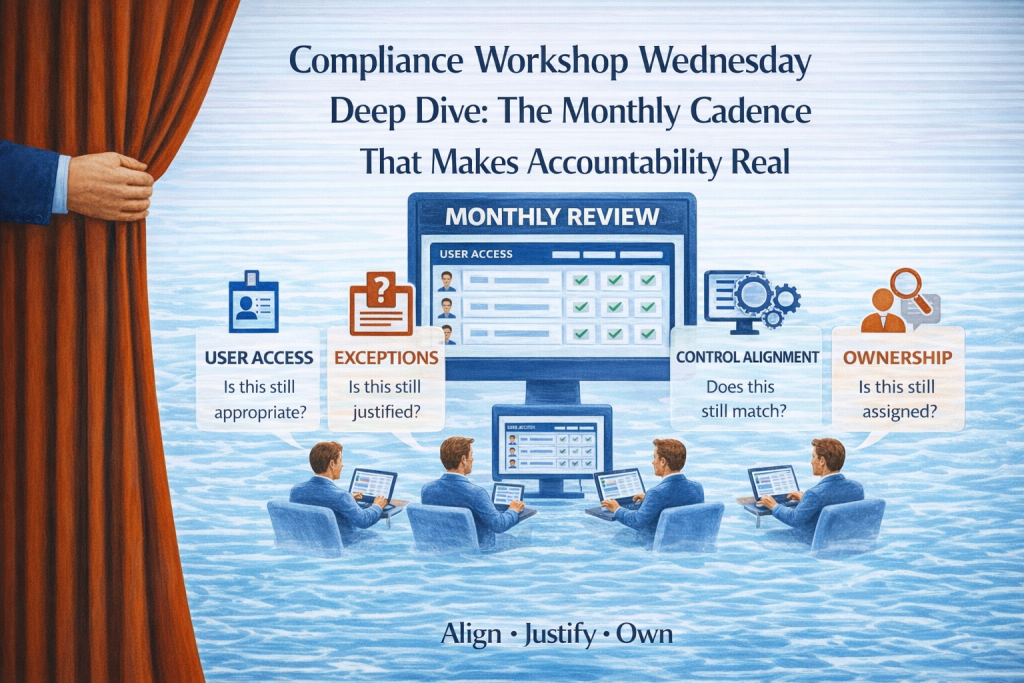
Don’t add complexity, add intention. Each month, step back from the noise of daily and weekly activity and focus on a few key areas:
- User access reviews, validating permissions with system owners rather than assuming they are still correct.
- Exception and risk reviews, making deliberate decisions about whether something is still acceptable or needs to be addressed.
- Control alignment checks, confirming controls still match how the business actually operates today.
- Ownership validation, ensuring the right people are still accountable and engaged.
Over time, this expands into a full review cycle in which every part of the environment is revisited deliberately. Without that rhythm, the environment does not usually fail all at once. It gradually becomes something different from what you originally secured.
The Part That Caught Us Off Guard
The biggest surprise was not what we found. It was how easy it was to assume things were still right simply because nothing had broken. That assumption is where drift takes hold.
Continuous controls tell you what is happening. Weekly cadence tells you whether it is working. Monthly cadence tells you whether it is still right. If you skip that layer, you can operate an environment that looks healthy for a long time while slowly moving further away from what you intended it to be. That is the risk, not failure, but misalignment.
The Question That Matters
At the end of each monthly review, we started asking a simple question: If we were assessed today, could the control owner confidently explain not just how this works, but why it still works this way?
That is what monthly cadence really proves. Not just that your controls exist, or even that they are running, but that they are understood, owned, and intentionally maintained over time. That is what turns compliance from a snapshot into something real.
Before moving on, here are the areas we recommend every organization includes in its monthly cadence:
- User access and permissions across critical systems
- Exception and risk register reviews
- Control ownership validation
- Control alignment with current business processes
- Privileged access reviews
- Group memberships and role assignments
- Policy exception tracking and approvals
- Security configuration baselines versus current state
Not all this needs to happen every month. However, over time each one should be revisited with intention, because this is where accountability becomes visible and where alignment is either confirmed or lost.
Next week’s deep dive: Quarterly cadence, where we build on the previous cadence to bring everything together.
Questions about CMMC certification? Contact Hill Tech Solutions.