Over the past several weeks, we’ve been walking through what our CMMC Level 2 achievement really means: not as a badge, but as a lived experience.
We’ve talked about why this matters for our customers, how roles and people (not tools) make compliance work, the practical wins that come from disciplined processes, and the lessons we learned by going through a real C3PAO assessment. Each post peeled back another layer of what CMMC looks like when it’s implemented and assessed in the real world.
This post builds on all of that; because understanding the journey only matters if it actually reduces friction for the customer.
Most organizations begin their CMMC journey with the same quiet hope:
“We hired a good MSP. They’ll help us through this.”
And in many cases, that’s true, up to a point.
The challenge is that CMMC isn’t assessed on effort, intent, or vendor relationships. It’s assessed at the objective level, and only one thing really matters when the assessor asks questions:
Who owns this control?
That question is where we see the journey either become predictable or painfully chaotic.
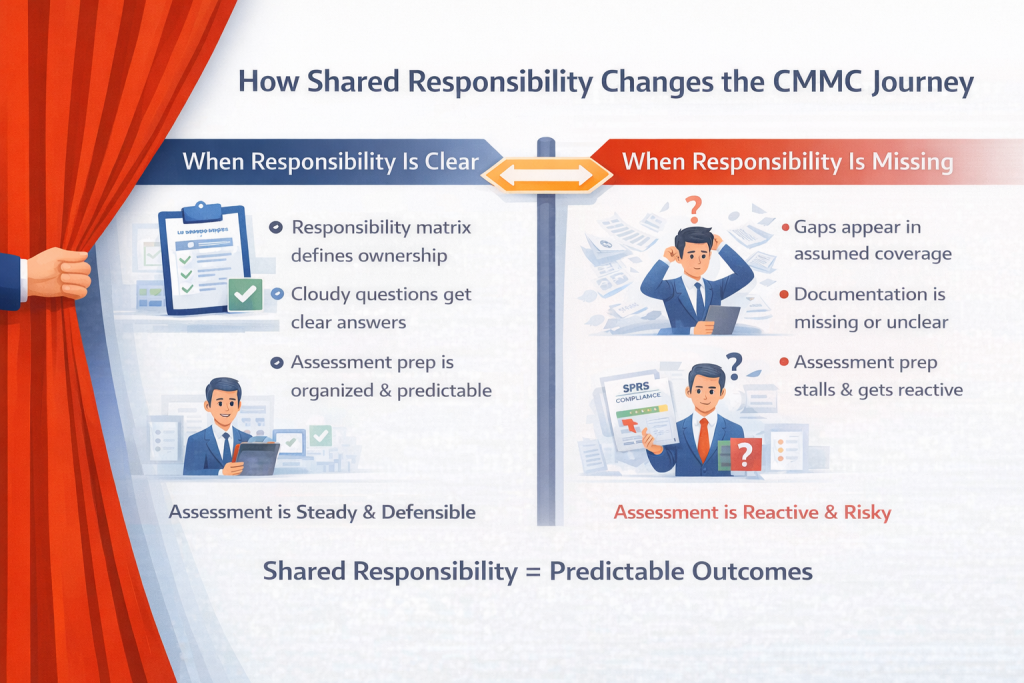
When Responsibility Is Clear, Progress Follows
There’s a moment we watch customers hit over and over again. It usually comes when they first see the NIST SP 800‑171 assessment objectives laid out in plain language and realize something important:
This isn’t about what tools are deployed.
It’s about who implements, who enforces, and who proves it.
That’s why our Customer Responsibility Matrix (CRM) is built objective by objective , not at a high‑level control summary. Each requirement clearly shows what belongs to the customer, what Hill Tech Solutions owns, what is owned by another external vendor, and what is genuinely shared.
By structuring the CRM in this way, we eliminate ambiguity and ensure that everyone involved understands their specific obligations. For every assessment objective, the matrix details who is responsible for providing evidence, who manages implementation, and where collaboration is required. This clarity is particularly important during CMMC assessments, where auditors want to see clear ownership and accountability for each control. Instead of relying on broad statements or generalized control summaries, the objective-by-objective mapping makes it easy for customers to identify gaps, prepare documentation, and confidently respond to assessor questions. It also helps prevent confusion and finger-pointing by specifying, in plain language, what is expected from each party; whether it’s the customer, Hill Tech Solutions, or another vendor. Ultimately, this approach streamlines the compliance process and reduces friction, turning a potentially chaotic journey into one that is predictable and manageable.
When customers see that mapping, something changes. The fog lifts. Instead of guessing, they know:
- What evidence they must provide
- Where vendor artifacts support but don’t replace their responsibilities
- Which objectives they are confidently claiming
- And where there are gaps to close
The CMMC roadmap stops feeling abstract and starts feeling manageable.
When There Is No Customer Responsibility Matrix
Not every organization gets that experience.
We regularly work with companies who previously partnered with External Service Providers that were technically capable but never documented responsibility. No CRM. No evidence. No objective‑level ownership.
At first, that doesn’t seem like a problem.
Until assessment preparation begins.
That’s when gaps surface. Controls that everyone assumed were “handled” suddenly belong to no one. Evidence can’t be produced because implementation was informal. Policies exist, but enforcement was never clarified. Logging is enabled, but no one was assigned responsibility for review.
Even worse, customers often discover that SPRS scores were calculated optimistically, based on assumptions instead of defensible ownership. What looked compliant on paper doesn’t hold up when traced back to assessment objectives.
At that point, remediation becomes reactive, rushed, and expensive; not because the customer didn’t care, but because responsibility was never clearly defined.
The Hidden Cost of “We Handle That”
One of the most damaging phrases in compliance is:
“Don’t worry, we handle that.”
Without a written Customer Responsibility Matrix, that statement becomes impossible to validate. Assessors don’t accept verbal assurances. They don’t credit intent. They look for documented ownership, implementation, and evidence.
When those elements aren’t mapped in advance, customers bear the consequences:
- Points are lost unnecessarily
- Controls must be implemented later in the journey
- Assessment readiness stalls due to unclear accountability
- Stress levels spike right when confidence is needed most
None of that is inevitable, but all of it is common when responsibility lives in people’s heads instead of documented matrices.
Shared Responsibility Done Right Reduces Burden, Not Accountability
A properly structured shared responsibility model doesn’t eliminate customer accountability. It removes ambiguity.
Customers still own their CUI environment. They still approve users, define processes, and maintain governance. But they don’t have to reinvent every wheel, duplicate evidence, or guess what an assessor will accept.
Standardized, assessment‑tested implementation combined with documented ownership dramatically lowers the operational burden without weakening compliance. It replaces uncertainty with alignment.
Why Assessment Experience Matters
There’s another difference customers feel when working with a provider that has already passed a CMMC Level 2 C3PAO assessment.
The CRM isn’t theoretical. It was challenged by assessors. They were validated against real questions, real evidence requests, and real objective testing.
That experience shows up in how our customers prepare. They’re not surprised by how controls are evaluated. They’re not scrambling to explain ownership. And they’re not revising SPRS claims at the last minute.
The journey isn’t easier, it’s clearer.
The Journey Should Never Be a Guessing Game
CMMC compliance isn’t meant to be blind trust or vendor dependence. It’s a shared effort, but only when responsibility is explicitly documented, understood, and executed.
When customers work with an MSP that lacks a Customer Responsibility Matrix, the journey often becomes reactive and risky. When responsibility is documented and aligned to assessment objectives, the path forward becomes steady and defensible.
That’s the difference shared responsibility makes.
Not inherited controls.
Not shortcuts.
But clarity, from the first SPRS submission to the final assessment interview.
Understanding the nuances of shared responsibility is crucial, but there’s another concept that often causes confusion: control inheritance. In our next post, we’ll dive into what control inheritance really means, and why it’s frequently misunderstood in the context of compliance. Stay tuned as we clarify how inherited controls impact your security posture and assessment outcomes.
Questions about CMMC certification? Contact Hill Tech Solutions.