In the previous installments of Compliance Workshop Wednesday, we shared what our CMMC Level 2 effort looked like behind the scenes, highlighted the roles that made the work sustainable, and outlined the practical outcomes that came from treating compliance as an operating discipline instead of a one‑time event.
This week, we want to focus on lessons learned: the realities that only surface once you are deep in the controls, evidence, and assessment process itself.
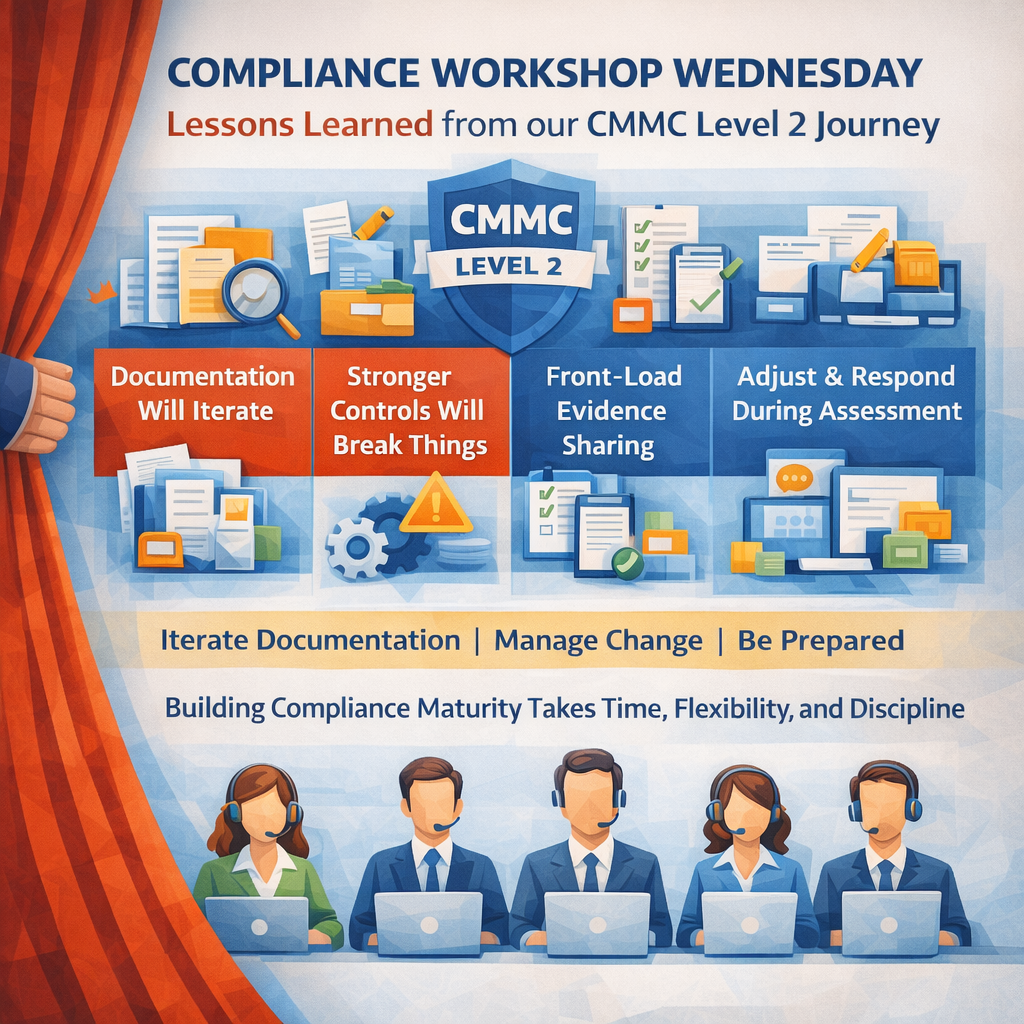
Documentation Will Iterate More Than You Expect
One of the earliest lessons was accepting that documentation is not a “write it once and move on” activity. As we worked deeper into individual controls, new edge cases surfaced. Scenarios that were not obvious during initial drafting became clear only after controls were implemented and tested in real operating conditions.
Each new edge case required refinement, clarifying language, tightening/expanding scope, or adding context so the documentation accurately reflected how the control actually worked. This iteration was not a failure of planning; it was a natural outcome of aligning written policy with real-world systems and workflows. For example, when a control was implemented in a way that differed slightly from the original plan, it was necessary to update the documentation to capture those variations. This meant not only adjusting descriptions and procedures but also ensuring that the rationale behind each change was clearly documented. Sometimes, a previously unconsidered scenario would prompt us to expand the scope of a policy or add additional clarifying details. Other times, we needed to tighten language to remove ambiguity and make expectations explicit for both internal stakeholders and external assessors.
Rather than viewing these revisions as setbacks or inefficiencies, we approached them as opportunities for growth. Each update brought our documentation closer to reflecting the true nature of our operations and the practical realities of managing compliance. By embracing an iterative mindset, we were able to foster a culture of continuous improvement, where feedback from implementation and assessment drove meaningful enhancements. Ultimately, this approach ensured that our compliance efforts remained robust, adaptable, and fully integrated into our daily workflows, setting the stage for long-term success. The key was to build time and flexibility into the process to allow documentation to mature alongside the environment.
Stronger Controls Will Break Things – Plan for It
As security controls became more stringent, things broke. Access paths changed. Automated processes failed. Workflows that had functioned quietly for years suddenly surfaced as exceptions.
This reinforced the importance of change management. Implementing controls without understanding downstream impact creates friction and frustration. Having a structured way to test changes, communicate impacts, and respond quickly when something fails made the difference between disruption and progress.
Security improvements are rarely invisible. Expecting change, and managing it deliberately, kept momentum moving forward.
You Can Never Be Too Prepared – Front‑Load Evidence Sharing
Another major lesson was around assessment readiness. No matter how confident you feel, you can never be too prepared.
We found significant value in front‑loading evidence and documentation to the assessor. Sharing artifacts early helped establish context, reduced back‑and‑forth, and allowed discussions during the assessment to focus on validation rather than discovery. By proactively providing key documentation and supporting materials ahead of the formal assessment, we ensured that the assessor had a comprehensive understanding of our environment from the outset. This not only streamlined the overall process, but also minimized interruptions during daily operations, as fewer urgent requests for clarification or additional evidence were necessary. Early sharing of evidence created a foundation of trust and transparency, enabling the assessment team to dive directly into verifying controls rather than spending valuable time piecing together basic information. Additionally, it gave us an opportunity to address any questions or concerns before the assessment began, resulting in more productive and focused conversations. Ultimately, front-loading evidence accelerated the assessment timeline and fostered a collaborative atmosphere, making the entire engagement smoother and more efficient.
Be Ready to Adjust During the Assessment
Even with strong preparation, assessments are dynamic processes. Throughout the engagement, assessors frequently requested small additions to evidence or minor clarifications within documentation. This ongoing need for adjustment highlighted that, regardless of how thorough the initial documentation and evidence collection was, unforeseen gaps and questions would inevitably arise. Such requests could include supplementary screenshots, clarification of procedures, or more detailed explanations for specific controls. The ability to quickly gather and submit these materials was crucial for maintaining momentum and demonstrating responsiveness, ensuring that assessors received the necessary information without unnecessary delays. Being agile in these moments signaled that the organization was not only well-prepared but also committed to transparency and accuracy.
Achieving this required a coordinated approach: designating team members ahead of time, maintaining organized repositories of documentation, and establishing clear communication channels for rapid response. When assessors identified issues or requested clarifications, it was essential for team members to promptly evaluate the request, locate or demonstrate the relevant evidence, and provide updates or corrections. A flexible workflow ensured that these activities did not hinder ongoing business functions or create project bottlenecks. Additionally, it fostered a sense of readiness and adaptability among staff, enabling them to address unexpected challenges efficiently and confidently.
Answer the Question Asked – Nothing More
One of the most subtle but important lessons was communication discipline.
When responding to assessor questions, the goal was to answer exactly what was asked, with just enough information to make the point clear, and no more. Over-explaining or volunteering information outside the scope of the question often creates confusion, introduces unnecessary follow-ups, or shifts focus away from the control being evaluated. Providing clear, concise answers grounded in evidence kept conversations efficient and productive.
Final Takeaway
CMMC Level 2 is not just a test of technical controls or documentation quality. It is a test of how well an organization understands itself, including its systems, workflows, and decision-making discipline. The biggest lesson we carried forward is that success comes from preparation, adaptability, and restraint. Build deliberately. Expect iteration. Manage change. Stay organized. Communicate clearly. This is the path to “Maturity.”
When those pieces are in place, the assessment becomes confirmation, not chaos. In the next installment of Compliance Workshop Wednesday, we will explore “Why this matters for our customers.” We’ll discuss how our rigorous preparation, adaptability, and communication discipline directly benefit our customers, ensuring their data is protected, their trust is maintained, and their business objectives are supported. By demonstrating maturity and compliance, we reinforce reliability and transparency, providing peace of mind to those who depend on us.
Questions about CMMC certification? Contact Hill Tech Solutions.